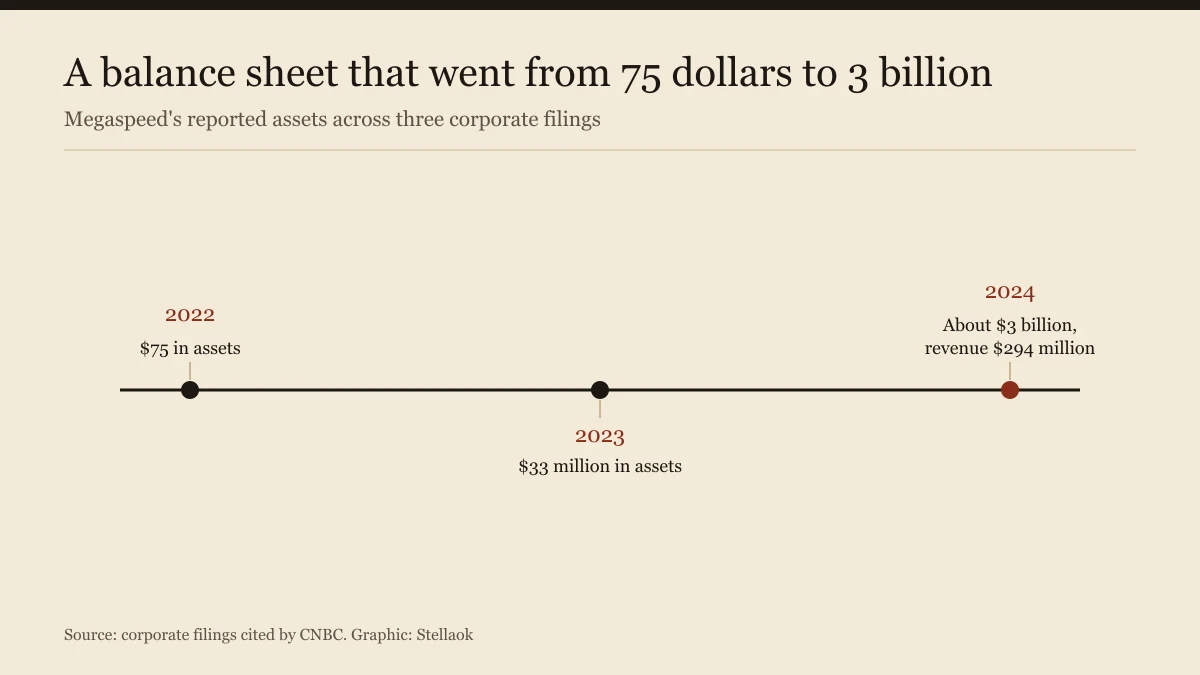
The company at the center of the Nvidia scandal barely existed three years ago. Megaspeed, the Singapore-based cloud provider suspected of funneling advanced AI processors to Chinese companies, reported assets of $75 in 2022, $33 million in 2023, and about $3 billion in 2024, with revenue going from zero to $294 million in a single year. According to The Information, executive Alice Huang used her personal relationship with Nvidia CEO Jensen Huang to move at least $7.5 billion worth of chips through Megaspeed and its Malaysian subsidiary Speedmatrix. The company denies all wrongdoing, and Nvidia has said it found no evidence of illicit transfers.
Who Alice Huang is matters to the story beyond the affair. US intelligence identified her as having been recruited by China's Ministry of State Security to gather information on Jensen Huang, according to people briefed on the intelligence cited by the New York Times, and Bloomberg reported she has returned to Beijing with the knowledge of Chinese security officials. Her corporate trail is unusually legible: she joined Megaspeed in early 2023, served eight months as managing director, and received one share for one Singapore dollar on the day she stepped down. The company itself had been incorporated in 2015 as 7Road International, a Chinese gaming firm with ties to state-backed investors, and was acquired by Singapore entity Swiftdata in November 2023.
The Malaysian subsidiary did the heavy lifting
Speedmatrix, established in 2024, bought at least $4.8 billion of advanced AI equipment between June 2024 and February 2026, according to trade records cited by the Times, and received over 200 shipments of restricted Nvidia technology in a single year of that window. The chips ended up powering data centers built by Shanghai Century Litong, a Chinese firm where Alice Huang's younger sister, Huang Yu, is a founding shareholder, and which sells AI computing capacity to Alibaba and Tencent. During a 2025 visit to a Speedmatrix data center, a US trade official found boxes of unopened Nvidia chips, though officials acknowledged they had no conclusive evidence of diversion at the time.
The money trail raises its own questions. Short seller Culper Research alleged in May that Megaspeed was "secretly financed by Alibaba via a series of apparent shell companies," including a large portion of a $4.2 billion tranche in March 2025. Two Malaysian entities linked to the group, Speedmatrix and MSFusion, list addresses in the same Johor development, and MSFusion, a company with no revenue, agreed to buy a 52.5-acre industrial parcel for 263.2 million ringgit before settling 225.9 million ringgit in overdue payments after a default notice.
Governments are responding where the law already reaches
The enforcement picture is uneven but moving. Singapore police opened an investigation into Megaspeed in October 2025, while the city-state separately denied reports that it had investigated Alice Huang herself. Malaysia's trade minister Johari Abdul Ghani said this week that no evidence against Speedmatrix had been presented and no investigation was open, while pledging the country would not become "a channel to circumvent export controls." Malaysian customs seized $12.1 million in AI chips at Kuala Lumpur airport in October, falsely declared as electronic components, and Singapore charged three people last year over diverted servers.
The regulatory gap the network exploited is narrower than it was. Renting Chinese firms access to compute housed outside China remains legal under current US rules, which is why Oracle's $7 billion deal to give Tencent access to 100,000 chips was canceled only after US officials raised concerns, per the Financial Times, and why the House has passed the Remote Access Security Act to close the loophole outright; it now sits before the Senate. Nvidia, whose board is weighing its chief executive's future over the same scandal, is reportedly telling cloud clients they must sell at least 51% of services to non-Chinese customers. The scarcity behind all of this enforcement is real on every side of the Pacific, with European buyers already hunting Blackwell chips they cannot get. Malaysia drew $94 billion of data center investment between 2021 and mid-2026 on exactly the openness now under suspicion, and the region's choices in the next year decide whether that trust survives. As National University of Singapore's Ja Ian Chong told Fortune, both powers will subject third countries to deeper scrutiny, and "perceptions that they are unreliable or duplicitous partners will only increase such pressure."
Source: Fortune