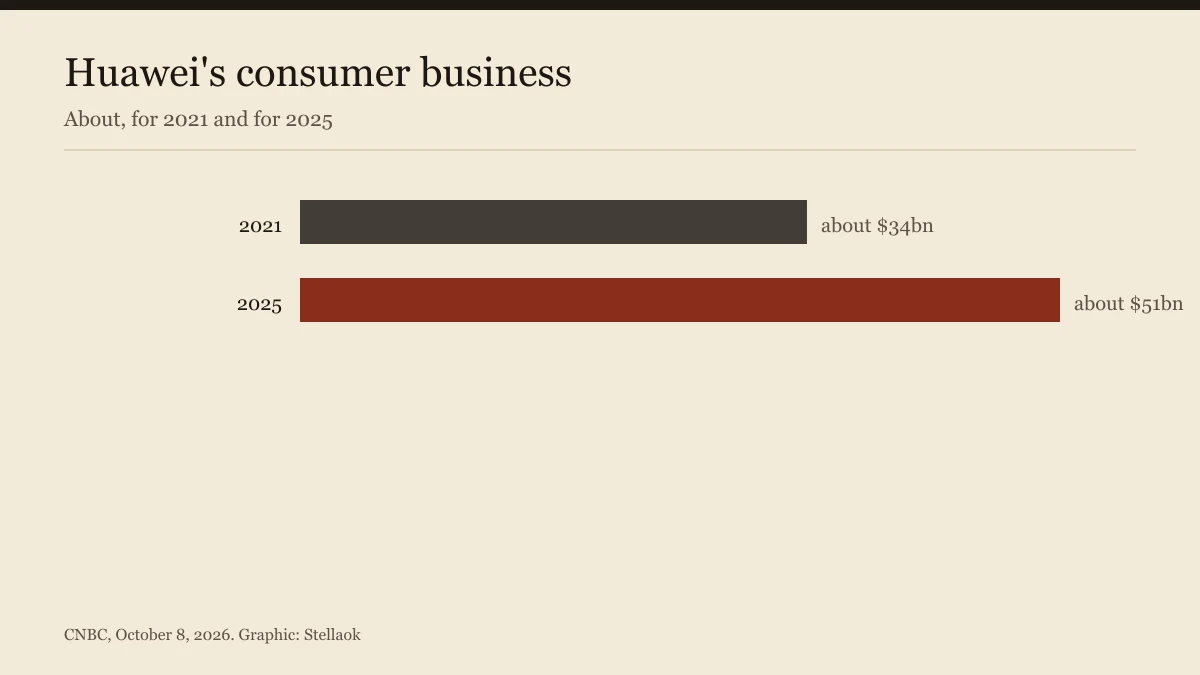
Huawei's consumer business is about $51 billion in 2025. That is the phone-and-device line Richard Yu is putting back at the center of the company, on a day when the cars that use Huawei's software are selling less. On October 1, 2026, China's National Day, Huawei released the Mate 90 series, its first smartphone built on an in-house chip it calls LogicFolding.
Yu, chairman of the consumer business and the executive who usually presents the phone and car events, told reporters ahead of the launch that the company wants its overseas phone share back. U.S. restrictions in 2019 knocked Huawei off a brief spell at the top of the market. He said Huawei then shipped more than 240 million smartphones, with a goal of 300 million units that year. Outside China, he said, the company now sells several million phones a year. HarmonyOS is supposed to reach overseas markets in the next one to three years, if China's chip plants can eventually support export of devices that use Huawei's own silicon.
CNBC's account from Beijing is the first time Yu has spoken with foreign press since 2019. That year the United States cut Huawei off from Google's Android and from TSMC-made chips. The consumer business, once the company's largest by revenue, halved to about $34 billion in 2021. The climb back to about $51 billion is the recovery he is talking about. Qualcomm, which used to collect Huawei's patent royalties, agreed this week to pay Huawei instead. The Mate 90 is the product that does not depend on that old supply line.
China's phone market is falling while Huawei pushes out
Counterpoint Research has China's smartphone sales in a double-digit decline from a year earlier in both August 2026 and September 2026. Huawei is launching into that slide, not into a boom. The overseas plan is still a hope tied to manufacturing capacity Yu does not have yet. The domestic plan is a holiday-week phone with a chip the company can name as its own.
The car unit is at least $6.7 billion, and September was down
Huawei's electric-car work is a partnership business, not a factory it owns. The company says it does not build the cars. It supplies the software interface and the driver-assist system, through Harmony Intelligent Mobility Alliance, or HIMA. The 2025 annual report puts that unit's revenue at at least $6.7 billion. Five vehicle lines come from partners including Chery and Seres. More than 1.56 million units have been sold since the first Huawei-powered car in late 2021. Yu showed the first of them, the Aito M5, in December 2021.
September 2026 deliveries of Huawei-powered vehicles fell for a third straight month, down 29 percent from a year earlier, to just under 37,500, by CNBC's tally of HIMA's public figures. BYD, the market leader, posted double-digit gains in each of the past three months, with sales well above 400,000 units a month. Leapmotor has delivered more than 100,000 cars a month since July. Tesla China had not reported September deliveries by Wednesday afternoon. Europe has already shelved or scrapped about $42 billion of data-center projects. Huawei's export problem is the opposite shape: the phones are what it wants to send abroad, and the cars have stayed in China.
Seres signed another five years on the holiday
China's auto market is on track for its worst year since 2021. Passenger-car sales are down more than 20 percent over roughly the first three quarters, using China Passenger Car Association data as of September 27, 2026. New energy vehicles, battery electric and hybrid, are down 13 percent in that stretch. Seres, which builds the Aito line, has seen its Shanghai-listed shares fall more than 60 percent this year. On October 1, Huawei and Seres signed another five years of cooperation, including a joint Aito business team. Mainland markets were closed for the holiday and set to reopen Thursday.
The $51 billion consumer figure is the phone business Yu is choosing. The 37,500 September deliveries are the car business he is not walking away from, on a new five-year piece of paper with Seres.