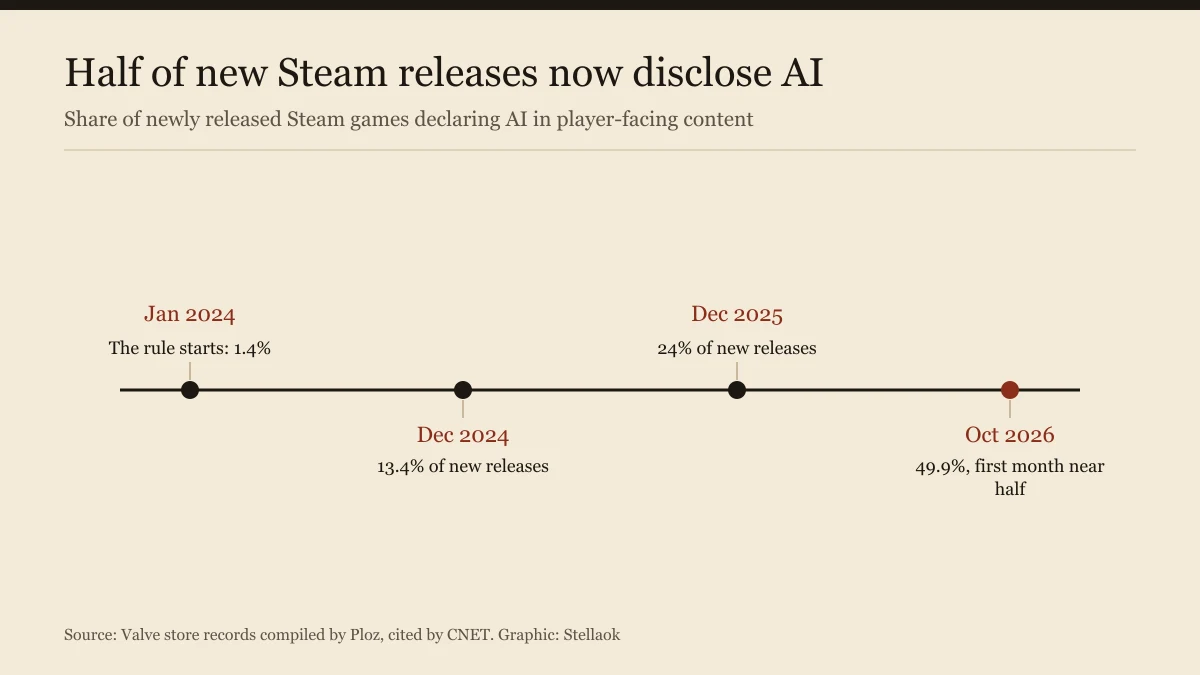
About half the games released on Steam in October carried a disclosure saying the developer used AI. The figure is 49.9%, compiled by a Reddit user named Ploz from Valve's public store records, and it is the first time the number has crossed 50% of a month's releases by the narrowest possible margin.
The disclosure field exists because Valve required it. In January 2024 the company told developers to state whether their game contains AI-generated player-facing content, meaning art, sound, dialogue or translation. At the time, 1.4% of new releases checked the box. It reached 13.4% by the end of 2024, 24% by the end of 2025, and now sits at 49.9%. Steam's catalogue has been growing faster than its curation for years, and the disclosure data is the clearest measure yet of what that growth looks like.
What the disclosures actually say
Artwork appears in 63% of the filings, text and translation in 30%, music in 21%, code in 16% and voice in 7%. About a quarter of developers also said they used AI for store pages and marketing copy. Roughly 3% use AI as part of the game itself, which is the category that costs real money to run: the driving game Teach My Little Sister How to Drive interprets voice commands with a model, and its studio Easy Fox pays $1,000 a day to keep a playable demo online, money it had to borrow.
The 49.9% is a floor for AI use on Steam, not a ceiling. The disclosure only covers player-facing content, so a team that uses a model to write code or chase bugs never has to mention it. A Google Cloud survey in August 2025 found 87% of developers use AI somewhere in the backend.
The audience is not following
Games with a disclosure review worse than games without one, and they sell less. Among releases with more than 1,000 reviews, only 17% carry the label. Among games with ten reviews or fewer, 47% do. Developers who shipped more than ten titles in a year disclosed AI on 68% of them, which points at volume shops rather than studios with a franchise to protect.
Valve's position is that it will not police the shelf. The company says the problem of low-effort releases exists but that it does not "want to be gatekeepers telling developers which tools they should or shouldn't use." Tom Giardino, a Valve developer relations staffer, has told developers they must keep adding features and personality that come from their own perspective. Epic takes a similar line on its store. Itch.io does not: it deletes AI-heavy submissions and lets users filter them out of search.
Studio silence is its own data point. CNET asked two dozen well-known developers, including Epic, EA, Activision Blizzard, Ubisoft and PlayStation Studios, for comment. All declined.
The bill arrives at the player
The practical effect is that a buyer cannot tell from the store page whether a game was drawn by a person unless they open the disclosure panel, and almost nobody does. Valve's policy puts the work of filtering on the customer, and the customer is already choosing on price and cover art. SteamDB has counted more than 44,000 games priced at $5 or less, which is the pool a new release has to surface from.
There is a counterweight, and it is small. Anthropic changed Claude Opus 5.5 to refuse requests to clone existing games, after its engineering lead Addy Osmani said copying games with the model violates intellectual property rights and the company's own policy. CNET's testing still produced games resembling popular titles, which tells you how much a prompt filter can do.
The next measurement to watch is the November and December disclosure rate. If it holds near half through the holiday release window, when full-price games ship, the label stops describing a fringe and starts describing the store.
Source: CNET