Google's Googlebooks went on sale today, and the pitch is a clean break from what Chromebooks were. This is a premium tier: five launch models, prices from $899, and an operating system that folds Android, Gemini and the desktop side of ChromeOS into one thing with full Play Store access.
Announced in May with almost no hardware detail, the devices reach US stores on October 4, with Canada, the UK, Ireland, France, Germany and Australia a day later. MediaTek picked the same day to announce the Dimensity CX C10 Max, the first chip in a new lineup that will power an upcoming Googlebook. Tom's Hardware got the specifications and they are worth reading closely.
The new flagship chip is the old flagship chip
MediaTek calls the C10 Max the flagship of the CX line, built on TSMC's N3 process with an all-big-core CPU. Eight cores, though not eight of the same core: one Cortex-X925, three Cortex-X4, four Cortex-A720. Eleven GPU cores on an Arm Immortalis-G925 MC11, plus the NPU 890 rated at up to 55 TOPS.
Line that up against the Kompanio Ultra 910, MediaTek's previous flagship for this class of machine, and the resemblance is hard to miss. Same core split. Same GPU. Same NPU. Same 12MB of L3 and 10MB of system-level cache. On the specifications MediaTek has released, the one real difference is memory speed, with LPDDR5X rising to 9,600MT/s from 8,533MT/s.
That core arrangement is also identical to the Dimensity 9400, 9400+ and 9500s phone chips, so the CX line looks like the same silicon design with a bigger power budget and higher boost clocks. Which may well be enough for a laptop. It is just not what the word flagship usually implies, and MediaTek's framing about elevating its compute portfolio is doing some work.
The performance claims need more caution still. MediaTek says up to 15% faster multi-threaded performance and 50% lower single-threaded power against Qualcomm's Snapdragon X Elite X1E-84-100, using Geekbench 6.5 with multi-threaded runs at 12W iso-power. The X1E has a 35W base TDP, and MediaTek did not clarify what power figure it used for the comparison. It also did not publish any actual scores, which leaves the single-threaded power claim unverifiable.
Then there are the test platforms. MediaTek's chip ran on a reference board under ChromeOS R133. The Qualcomm chip ran in a Samsung Galaxybook 4 Edge under Windows 11. The two systems match on memory capacity and battery size, and on nothing else that matters. Different operating system, different thermal design, different firmware.
PD Rajput, MediaTek's VP of computing platforms, was at least direct about the target. "In the category of devices we're looking at, and the segment we're on, it's the X1E we're competing with," he said, meaning Qualcomm's previous generation rather than the newer X2 series. No comparisons against AMD or Intel x86 parts were offered. The chip will not trickle down to Chromebook or Chromebook Plus machines, and the company says it is confirmed for Googlebooks only. The 19-hour battery claim also came off a reference board with a 60Whr cell, which makes it a system-level number dressed as a chip-level one.
What $899 to $1,299 actually buys
None of the five launch machines use the MediaTek part. The first wave runs Intel Panther Lake and Qualcomm Snapdragon X Elite, with OLED touchscreens, haptic touchpads and backlit keyboards across the range.
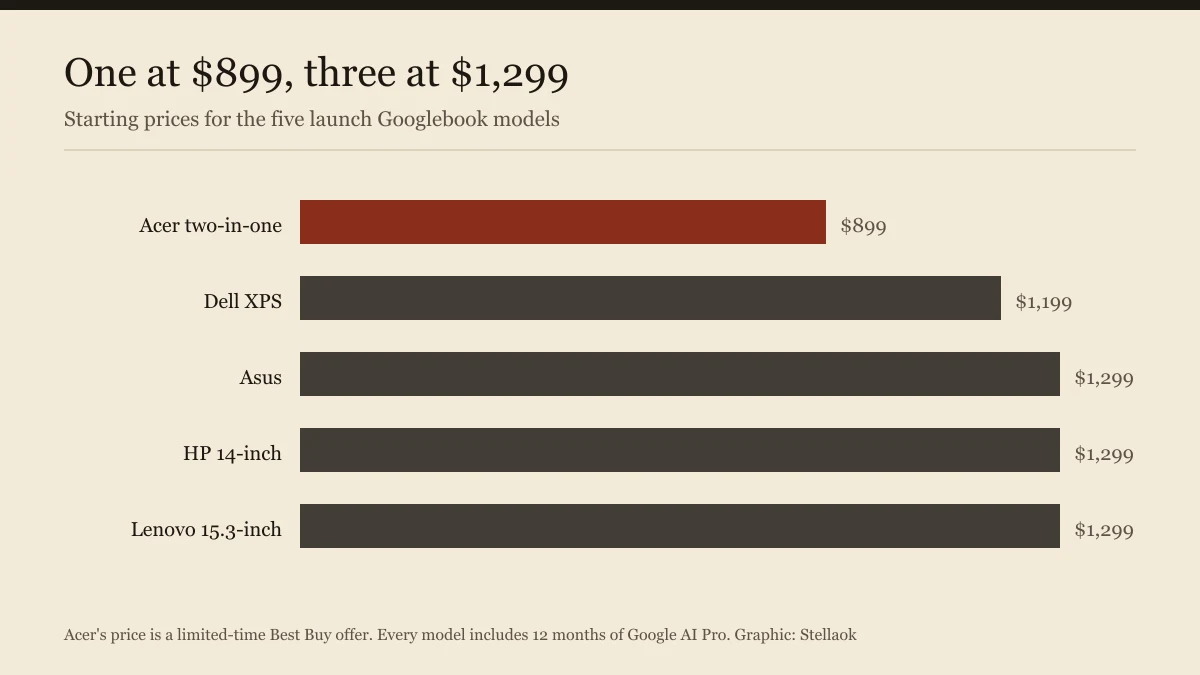
Dell's XPS is the smallest at 2.2 pounds in a full aluminium body, starting at $1,199. The Windows XPS 13 with the same look starts at $799, so the Googlebook premium is real. Lenovo brings the largest screen, a 15.3-inch OLED in magnesium alloy and carbon fibre at 2.8 pounds, for $1,299. HP's 14-inch all-aluminium model is 2.7 pounds at $1,299. Asus takes the ceramic-finish approach borrowed from its ExpertBook Ultra line, 2.2 pounds, also $1,299.
The $899 headline belongs to one machine: Acer's two-in-one, the only convertible in the group, magnesium and aluminium at 2.5 pounds. Acer's own materials describe that price as a limited-time Best Buy offer, so the entry point may not stay there.
Every purchase includes 12 months of Google AI Pro, normally $200, with 5TB of storage and Gemini Advanced. Three months each of YouTube Premium and Adobe Photoshop come with it, plus a year of Nvidia GeForce Now. Ten years of operating system updates carry over from the Chromebook programme, which remains the strongest argument in the whole package.
Whether the premium holds
Stack the software bundle against the price gap and roughly $400 of the Dell's $1,199 is accounted for by subscriptions in year one. That is a reasonable trade for someone who would buy those services anyway, and irrelevant to everyone else.
The real bet is on phone-to-laptop continuity for Android users, the thing Apple has monetised for a decade. Premium Chrome hardware has failed before because the software ceiling was the browser, and Googlebook OS exists to raise that ceiling. Whether Play Store apps behave well at 15 inches with a trackpad is the question that decides this category, and no specification sheet answers it.
For buyers weighing the alternative, the mid-range Windows market is where the pressure comes from, including machines like the $699 Acer Swift Air 14 that undercut all five of these while running the full desktop software catalogue. Component pricing is not helping either, with memory costs distorting system prices across the industry at exactly the moment Google wants to sell a $1,299 laptop on the strength of its operating system.