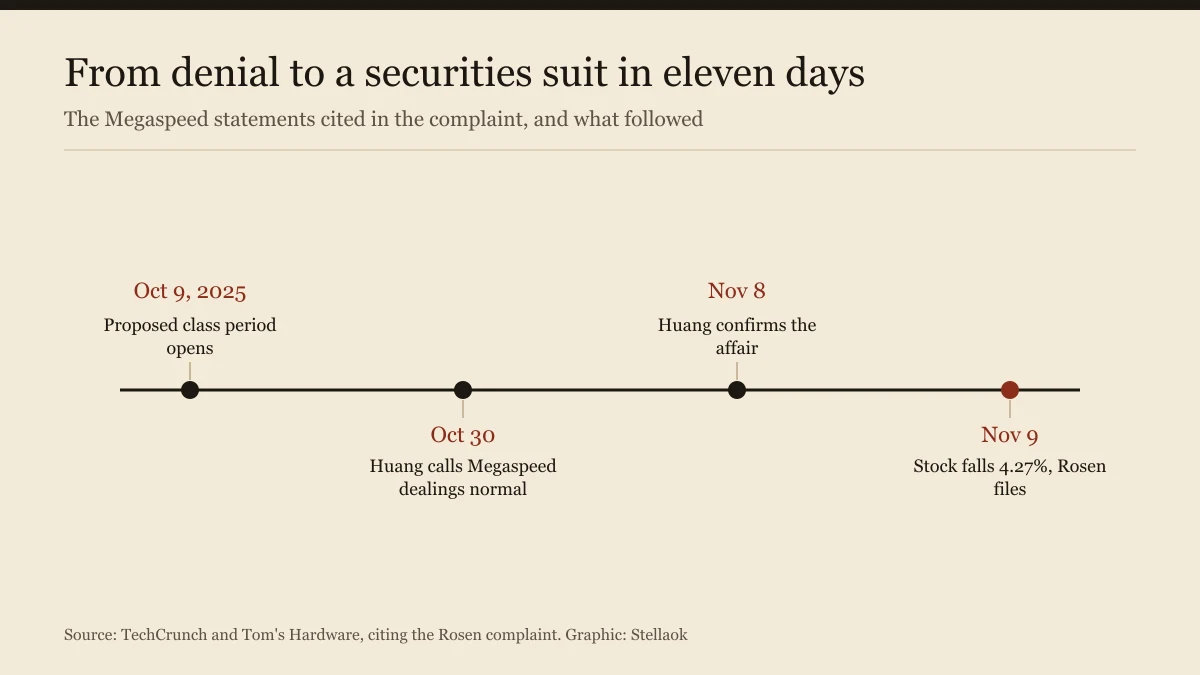
Rosen Law Firm filed the first securities class action against Nvidia on Monday afternoon, naming the company and CEO Jensen Huang as defendants in the Northern District of California, where Nvidia is headquartered. The complaint arrived hours after Nvidia's board said it would examine Huang's relationship with Alice Huang, an executive whom U.S. intelligence believes was working for China, and after the stock closed down $7.97, or 4.27%. The board's own inquiry was announced on Sunday.
The filing and who it covers
The plaintiff is Mark Kistenmacher, a retail investor whose purchase schedule attached to the complaint lists seven buys of Nvidia securities totaling roughly $20,500 this year. The proposed class runs from Oct. 9, 2025 through Nov. 8, 2026, a window that stretches back more than a year before the scandal broke.
Rosen specializes in securities class actions and was lead counsel in a $250 million settlement with Alibaba. At least four other firms, including Schall, Brown & Schwartz and Levi & Korsinsky, announced investigations the same day into whether Nvidia misled investors, and Tom's Hardware counts several more, among them Frank R. Cruz and Bronstein, Gewirtz & Grossman, citing premarket and intraday declines in the 5% to 9% range. None of these notices requires upfront fees from investors.
The three statements the complaint targets
The suit accuses the defendants of misleading investors about Huang's ties to Megaspeed, the Singapore-based data center company where Alice Huang was considered a top executive. It rests on three public statements: a late-October comment from Nvidia spokesperson John Rizzo that Huang's interactions with Alice Huang were "not unusual or unexpected"; an earlier company claim that it found "no evidence of diversion" of its chips; and Huang's own Oct. 30 remark to Bloomberg that Nvidia's dealings with Megaspeed were "normal and not unusual."
Stanford law professor Robert Bartlett, who studies securities law, told TechCrunch on Monday morning that he expected a filing before the day ended. In his view the company's earlier statement was "clearly a misleading statement," and because Huang runs the company, "his knowledge gets imputed to the company." Under federal securities law the first complaint triggers a public notice, and investors then have 60 days to ask the court to be named lead plaintiff, which gives early filers a head start on signing up large losers. Kistenmacher has already said he is willing to serve.
What the legal exposure looks like
Bartlett expects a "classic fraud on the market" claim: investors argue they paid prices that reflected false public statements and lost money when the truth emerged. The 4.27% one-day drop gives the lawyers their damages figure to work from, and with Nvidia among the most valuable companies in the world, a settlement could be expensive. The money would come from the company and its directors-and-officers insurers, typically with no personal consequence for the CEO, and it would ultimately be paid by shareholders, the same people the suit is filed on behalf of.
The wider exposure sorts into buckets. Governance comes next: directors have oversight duties, and once reporting on the Megaspeed connection began, the company should have had reporting lines to surface a risk of this size to the board. A finding that Huang knew about the intelligence connection would, in Bartlett's words, be "a whole other ball game." The board has said it has no reason to believe national security or Nvidia secrets were compromised.
The SEC could technically seek an officer-and-director bar for intentional fraud, though Bartlett doubts Chairman Paul Atkins' agency has the appetite given President Trump's support for Huang, who has positioned himself as an opponent of AI rules in Washington. A roughly two-year clock after discovery would leave room for a later administration, but the window is tight. None of this touches the chip business itself, where buyers locked out of the Chinese market have been hunting capacity in Europe and Huang has spent the past year campaigning against the AI rules his own company now answers for.
Source: TechCrunch, Tom's Hardware