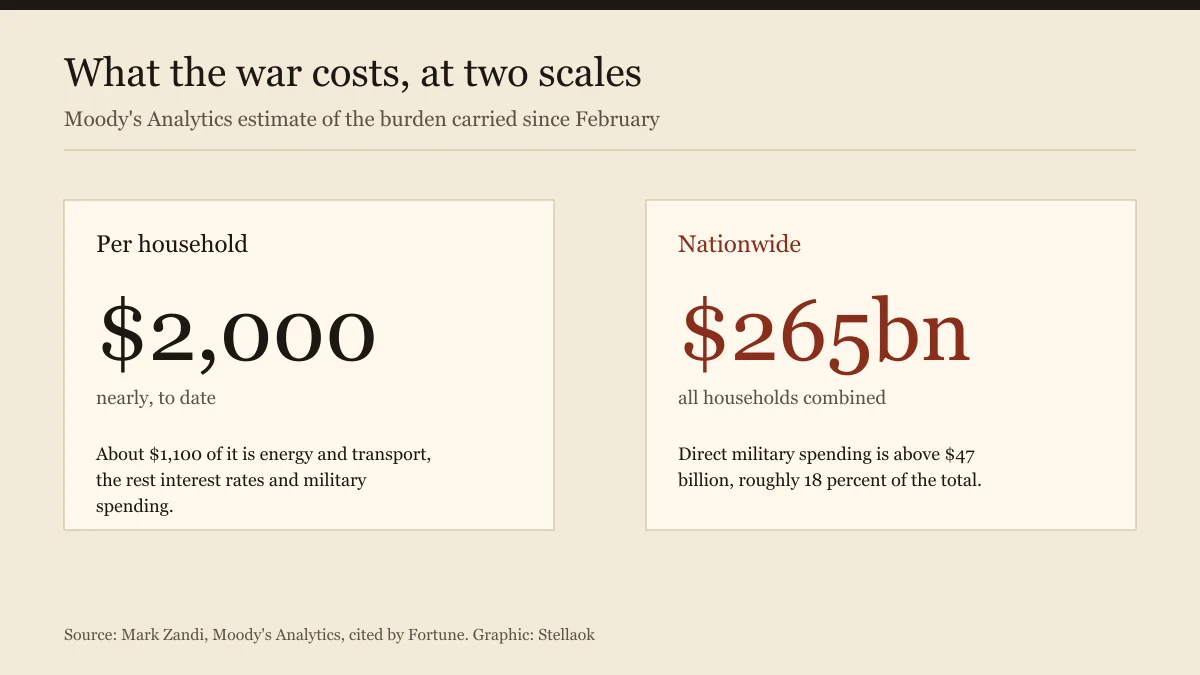
The war with Iran has cost the average United States household nearly $2,000, according to an estimate by Mark Zandi, chief economist at Moody's Analytics. About $1,100 of that comes from higher energy and transport costs, with higher interest rates and a share of military spending making up the rest. Nationwide the figure comes to $265 billion.
The estimate was published before this week's strikes. On 2 November, the day before the midterm elections, United States forces hit Iran's Qeshm Island. Officials told CNN the attack was a defensive response to Iranian forces using surface-to-air missiles against American assets, and told ABC News that similar limited strikes had been carried out over recent weeks without being publicised.
Fortune reported the cost estimate and the strikes. The timing is what makes it a market story rather than a budget story.
The exit that markets priced on 4 November
Brent crude fell more than 9% on 4 November as traders bet the election result would push the White House toward a deal, and the president said he had no immediate plans to strike Iran. That was the same week the bombs fell.
The contradiction is not hidden. On 8 October President Donald Trump posted that there would be no attack before the election. The Qeshm strike came the day before polling, and in a Fox News interview that night he suggested there had been no recent fighting.
Gilbert Metcalf, a visiting professor at MIT Sloan and a former deputy assistant secretary at the Treasury, told Fortune that the risk is not the size of these strikes but what they invite. "Continued strikes against Iran, albeit so-called 'defensive strikes,' only increase the likelihood of their undertaking those attacks," he said, referring to Iranian action against shipping in the Strait of Hormuz or against regional oil and gas infrastructure.
Hormuz is the number that sets the price
Before the war the strait carried about 20 million barrels a day. Qeshm Island sits roughly 14 miles from the Iranian port of Bandar Abbas, which is what gives Iran leverage over traffic through it, and Iran has stepped up attacks on commercial ships in recent weeks.
There is no cheap substitute for that route. Metcalf said last month that even Saudi Arabia's plan to send 10 million barrels a day around Hormuz may barely move prices, because the bypass capacity does not cover the volume and the rerouting adds distance to every cargo.
Shipping has already repriced once this year on exactly this logic, when container fuel costs stayed high even as supply fears eased. Freight does not fall as fast as it rises, which is one reason the household estimate keeps climbing even in quiet weeks. Oil had a brief relief rally when extra Saudi supply overshadowed new Houthi attacks, and that pattern is now the template: a headline moves the price, the physical market catches up later.
The military bill is the smaller half
The Pentagon has spent more than $47 billion on the war, Reuters reported on 27 October, up from the $37.5 billion Defense Secretary Pete Hegseth estimated in July. More than $29 billion of it goes to replacing munitions, which is spending that buys no new capability.
Set against the $265 billion cost to households, direct military spending is roughly 18% of the total. The rest is the price of energy and the price of money, which is why the war shows up in a mortgage payment before it shows up in a defence budget.
The inflation channel runs through the pump
The inflation channel is already visible in the labour data. Real pay has been falling as price growth outran wage gains, and energy is the component that moves fastest in both directions.
The war's political economy has become explicit. Vice President JD Vance said after the result: "The reason we lost is the war." That is a statement about an electorate, and it is also a statement about what the next administration, whichever it is, has to buy its way out of.
Winter is the next test. Home heating demand arrives on schedule, the ceasefire that collapsed in August has not been replaced, and the Congressional Research Service described the conflict as a war of attrition in September. The number to watch is not the household total. It is whether Brent holds below $100 through January, because that is the difference between an estimate of $2,000 and a floor.