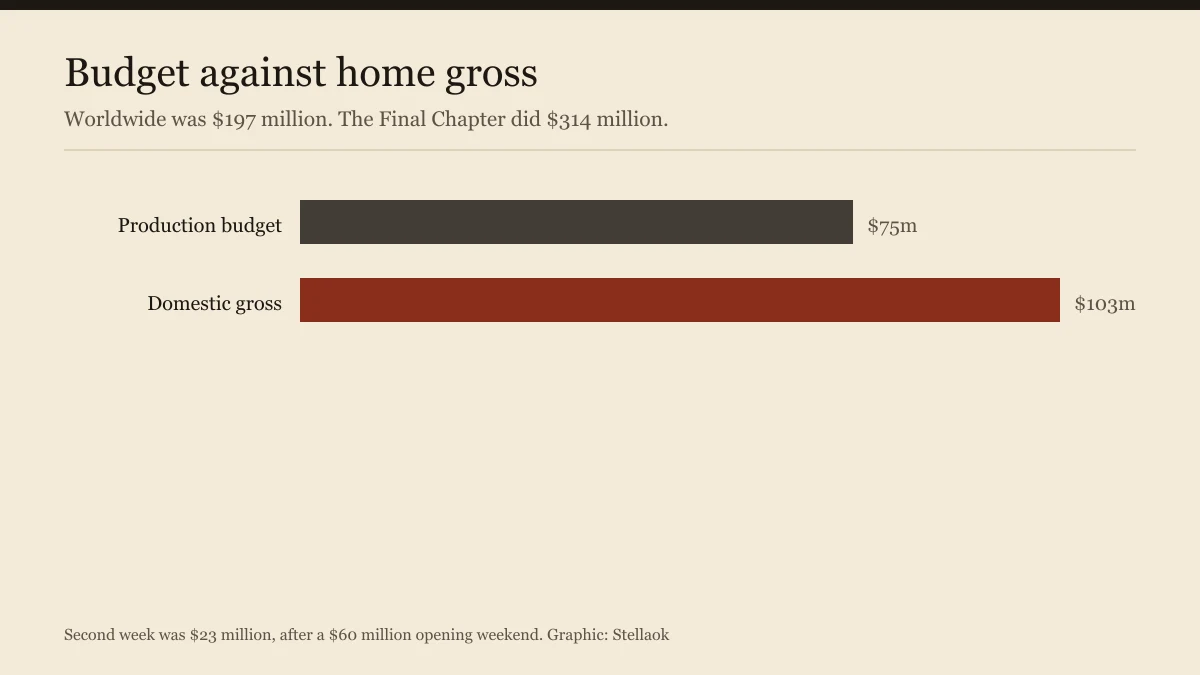
Zach Cregger's Resident Evil has grossed $103 million in the US and Canada, and $197 million worldwide. Sony spent $75 million making it.
PC Gamer, using The Numbers and a second-week figure via Fangoria, also has the opening: $60 million. The second week in the US and Canada was $23 million, behind a re-release of Avengers: Endgame and ahead of Brad Pitt's The Heart of the Beast and the Chris Hansen biopic Primetime. The film has been out a couple of weeks.
$103 million is already 1.4 times the budget, at home
One hundred and three divided by 75 is about 1.37. Domestic receipts alone cover the production budget and leave roughly a third again. Worldwide, 197 divided by 75 is about 2.63. The domestic share of the worldwide total is 103 divided by 197, about 52 percent.
The second week is 23 divided by 60, about 38 percent of the opening weekend. Those are different windows, a full week against three days, so the ratio is not a weekend-to-weekend hold. It is the only comparison the writeup supports.
PC Gamer calls this the top domestic Resident Evil film, with Paul W. S. Anderson's Afterlife in second, and Degeneration and Extinction contending for third. It does not print those films' domestic totals. Worldwide it ranks Cregger fourth, behind The Final Chapter at $314 million, then Afterlife and Retribution. One hundred and ninety-seven divided by 314 is about 63 percent of The Final Chapter's worldwide gross. The headline also calls the new film the third-most lucrative in the series while the worldwide list puts it fourth. The grosses are the part that can be checked. The rank depends on which column you read.
A horror series that makes its money in two different places
A film that leads the franchise at home and sits fourth in the world is a domestic hit with a softer international multiple. The Final Chapter's $314 million is the bar that is still well above $197 million. Afterlife and Retribution sit between them, at totals this article does not quote.
The $23 million second week also says the film is still selling tickets after the fans who were going to show up on opening night have done so. Beating a Pitt thriller and a Hansen biopic in week two is a comparison, not a ceiling. The Endgame re-release is a special case, a library title put back in theaters ahead of Avengers: Doomsday.
The game this film is selling is not in these numbers
Box office does not say whether players come back. It does say Sony has a Resident Evil movie that has cleared its production cost without waiting on the rest of the world. The series on film has usually needed the international column. This one has not, at least not to get past $75 million.
The game story we have is about the ending, a cure, and a sequel hook. Silent Hill's recent game left the original town, which is the other survival-horror revival running at the same time. A publisher dumping 29 games on Steam in a day is the opposite kind of release, volume instead of a single $75 million bet.
Add the two reported domestic chunks. The $60 million opening weekend plus the $23 million second week is $83 million. Total domestic is $103 million, so about $20 million landed outside those two windows. Twenty million divided by 103 is roughly a fifth of the domestic gross, earned on the weekdays and any later days the writeup does not break out. That is a sturdier description of the run than a franchise rank that changes with the column.
What would move the ranking is another two weeks at anything like $23 million. Another $46 million domestic would put the US and Canada near $149 million. The worldwide gap to $314 million would still be more than $100 million even if foreign grosses stalled. The film does not need that to be a financial success on the budget it had. It needs it only if the claim is that this is the biggest Resident Evil movie, rather than the biggest one at home.