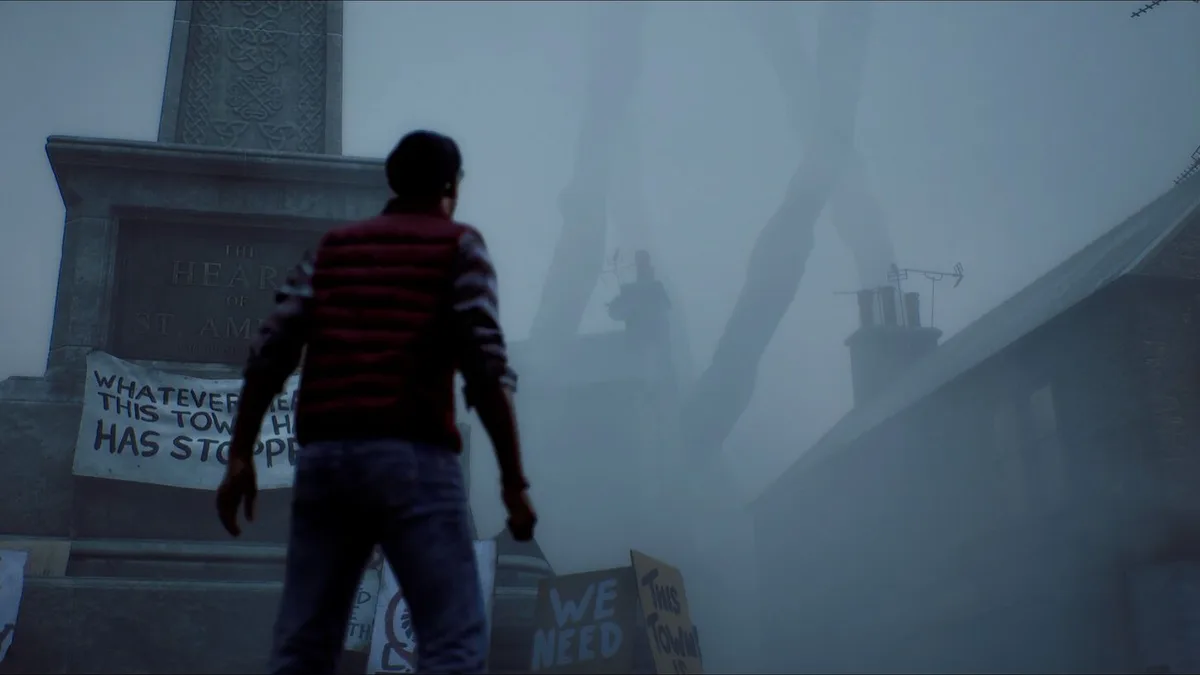
Silent Hill: Townfall arrives on September 24 at $50, developed by Screen Burn and published by Konami, and it is not set anywhere near Silent Hill. The location is St Amelia, a fictional fishing village on an isolated Scottish island, and the protagonist is Simon Ordell, who washes up out of the North Sea knowing nothing about himself beyond what a medical bracelet tells him: name, date of birth, blood type.
PC Gamer scored it 89 and GameSpot's reviewer called it the entry that completes the series' comeback. Both agree on what the game is doing well, and one detail in PC Gamer's account is more interesting than the score.
The horror is architectural
The island has two halves. The old town is cobblestone and cottages, a sleepy fishing village detailed enough that PC Gamer's reviewer described losing time to information boards about local fishing history and looking over fences at how residents had done their gardens.
Then it changes. Cobblestone becomes tarmac. Cottages become flats built for efficiency. The reviewer's word for that transition is painfully familiar, and it happens as Simon moves away from the heart of St Amelia and toward whatever has attached itself to the island. Among the locations the game takes you through, alongside a hospital, a corporate office and the series' traditional supernatural other place, are new builds.
That is a specific choice and it is the most Silent Hill thing about the game. The series has always worked by taking a place that should feel safe and making it wrong. Setting the deterioration along the seam between a heritage village and its modern expansion means the unease attaches to something British players already have opinions about, which is a sharper instrument than fog and monsters on their own.
Konami opening the franchise beyond America is the enabling decision here. A Scottish island is not a reskinned American small town, and the specificity is the point. PC Gamer's reviewer, based in the UK, wrote about feeling like she had been to St Amelia before.
What is actually new mechanically
The addition is the CRTV, which serves as both a puzzle tool and a stealth tool. PC Gamer's verdict names it as the thing that separates Townfall from a straight revival, sitting alongside the classic psychological horror and the grotesque monster design rather than replacing either.
The puzzles work the way the series always has. They reward lateral thinking, start easy enough to teach the method, and expect you to absorb everything in the environment before assembling an answer. The example given is finding a lock combination by sifting through letters scattered nearby, which is the oldest trick in the catalogue and still works.
Combat and threat are handled traditionally. Simon arrives with no flashlight, no healing items and no weapon. The monsters are faceless and bound. The reviewer logged 35 minutes and five seconds hiding in lockers across the playthrough, which is a more useful review metric than most.
The numbers a buyer needs
Thirteen hours to complete. That is short for $50 and long enough for a horror game that depends on sustained tension, and the review treats the length as appropriate rather than thin.
No multiplayer. Steam Deck compatibility is listed as unknown, which for a Konami horror release on PC is worth checking before release day if that is your platform. The review machine was an RTX 3070 with a Ryzen 5 5600G and 16GB of RAM, so this is not a game demanding current-generation hardware.
The pricing is $50 or £45, below the $70 that has become standard for major releases. Konami positioning a numbered-in-spirit Silent Hill entry under full price suggests a mid-budget production rather than a flagship, which matches a 13-hour single-player game from a studio most players have not heard of.
Whether the comeback claim holds
GameSpot's framing of Townfall as completing the series' revival implies a run of entries that worked, which is a reasonable read of where Silent Hill has got to. The more cautious way to put it is that Konami has now done this twice without the result being a nostalgia exercise, and has done it by handing the property to a studio that had its own idea about where the series should go.
That is the harder part of reviving a franchise. Fidelity is achievable and mostly technical. Letting a new team relocate the whole thing to the North Sea and build the dread out of housing policy takes a publisher willing to be surprised. Other studios working through similar questions have been less certain, with CD Projekt's Dawnwalker sequel reportedly dropping the timed clock that defined its predecessor, and Resident Evil closing its latest entry on a mutation and a sequel hook rather than a change of direction.
Townfall is out September 24 on Steam.