On September 15, a publisher called Hard Shark Games released 29 games on Steam. Racing, retail sim, survival horror, sport, flight sim, 2D platformer. All in early access, all with the same company listed as developer.
Every one of those store pages opens with the identical sentence: "We're launching in Early Access to involve the community from the very start." PC Gamer went through them and found the same line on Speedboat Simulator and Toy Battlegrounds: Shoot 'Em Up Survival from a previous batch of 29 released on March 4 last year.
The patch notes are copy-pasted too. Starship Fighters, Sky Combat and Streets of Rageness all open their March 5 update with "Optimized several core systems, resulting in smoother gameplay and up to 10% better overall performance, especially during longer sessions." The three posts went up within five minutes of each other.
The arithmetic is why it works
A Steam store page costs $100, refunded once a game clears $1,000 in adjusted gross revenue. Twenty-nine pages is $2,900 up front.
Using the Boxleiter method, which estimates sales from public review counts, PC Gamer put ranges on three of the 29. Supermarket Life Simulator at $295 to $885. Pool at $926 to $2,780. F1 Simulator at $562 to $1,686. Take the low end of all three and you get $1,783 in five days, from three titles out of 29. Take the high end and the entire $2,900 outlay was cleared before the first week was out.
That is the whole business model, and it does not require a single game to be good. It requires them to be cheap. Supermarket Life Simulator appears to be built on the $50 Checkout Frenzy Unity template, one that a lot of retail sims on Steam use. There is nothing improper about starting from a template, but PC Gamer found identical grocery imagery between the game's screenshots and the template's, and Steam reviewers call it a straight asset flip. Elsewhere, a screenshot for a game titled Axe Slasher appears to contain Kratos.
Every one of the 29 carries an AI disclosure for its capsule art and for nothing else in development.
Nobody is playing them
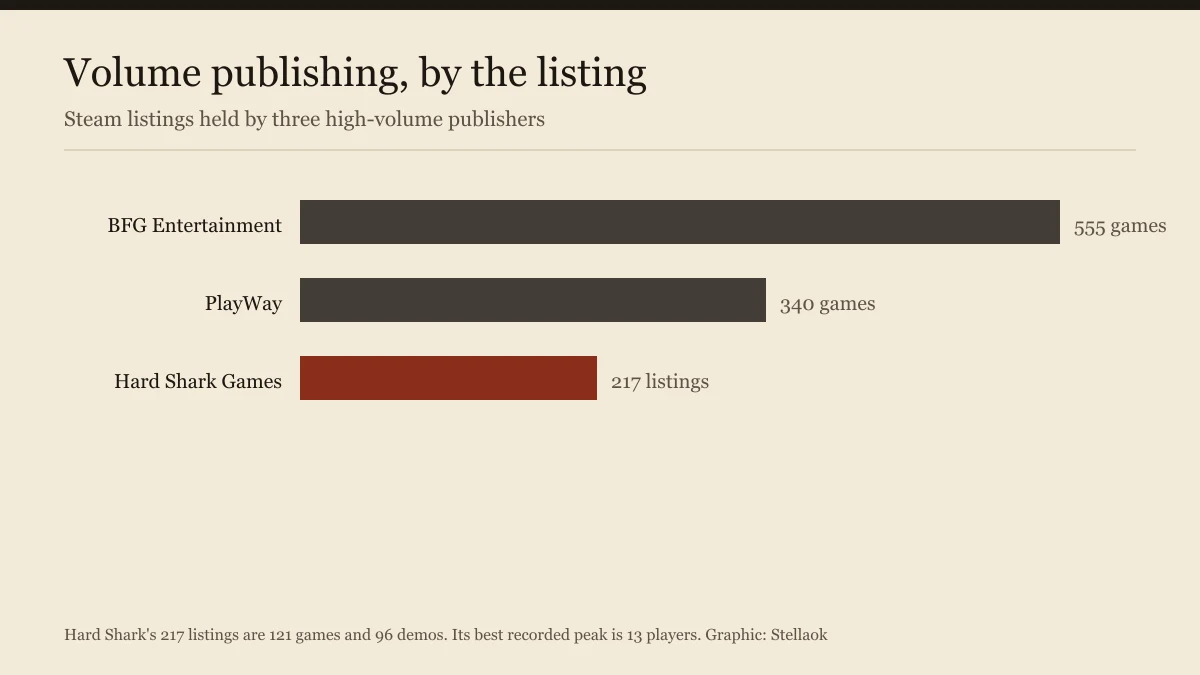
Here is the number that reframes the story. Hard Shark Games has 217 Steam listings, 121 games and 96 demos. Across all of them, the highest peak concurrent player count ever recorded is 13.
That record belongs to a demo, Supermarket Simulator Pro Demo, which has since been pulled.
So this is not a business built on players. It is built on discovery surface. Enough store pages, enough genre keywords, enough wishlist impressions, and a small fraction of Steam's traffic converts at $5 or $10 a time without anyone needing to enjoy the result. If the operation is one person running templates, a few thousand dollars of gross revenue against $2,900 of fees and $50 asset packs is a working margin.
And Hard Shark is not even close to the top of this league. BFG Entertainment has released 555 games. PlayWay, long the reference point for fast-turnaround retail sims, has 340. PC Gamer has asked Hard Shark Games to explain its method and had no answer at the time of writing.
What Valve is actually optimising for
The uncomfortable part is that none of this breaks a rule. The $100 fee exists precisely to price out zero-effort submissions, and it demonstrably does not, because the fee is recoupable and the conversion maths still closes.
Raising it would hit genuine solo developers hardest, which is the argument against doing so, and it is a real argument. Valve's historical position has been to let the store carry almost everything and let ranking sort it out, an approach that runs through most of its policy decisions including the rule about hackers that has held up for two decades. The cost lands on players scrolling past 29 near-identical listings, and on small studios competing for the same shelf space while genuine announcements go unnoticed in the volume.
The rest of the week's chart tells you what the store looks like when it works. Wardogs took number one in its launch week, unusual for an early access multiplayer game in that the discussion was not about what was broken. The Blood of Dawnwalker slipped from first to tenth in its second week, a respectable result for a single-player RPG, and outperformed Onimusha on PC, which moved from sixth to thirteenth. Halloween: The Game charted despite being refused classification in Australia.