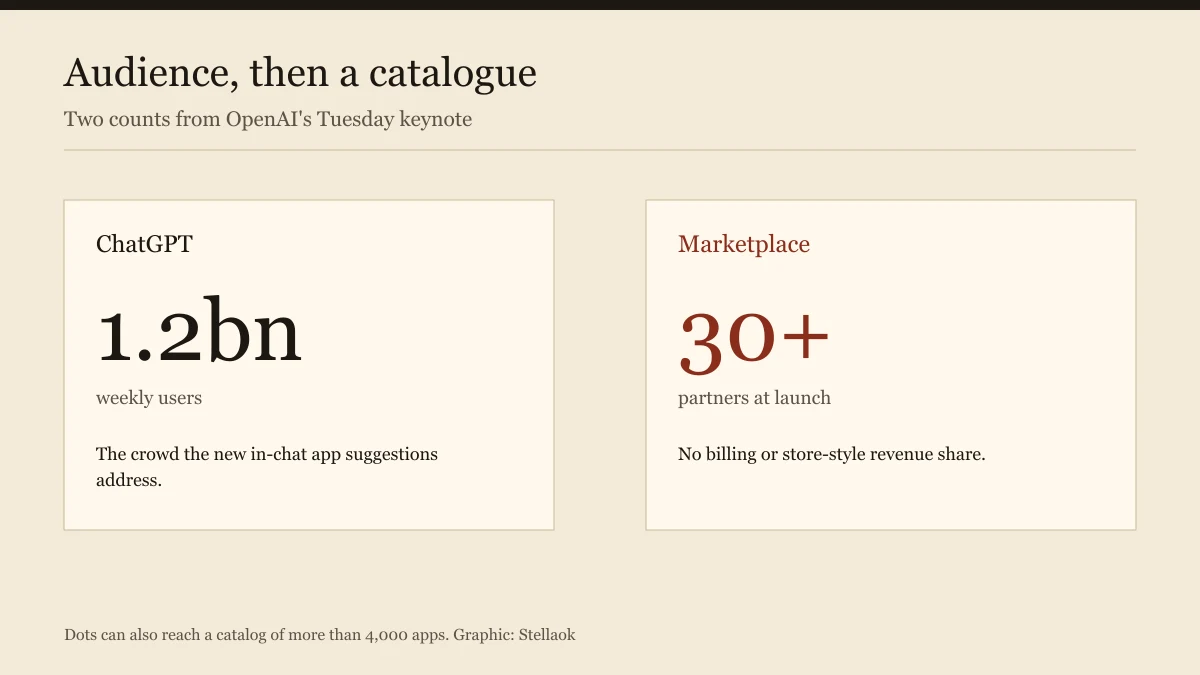
ChatGPT has 1.2 billion weekly users, OpenAI said on Tuesday. The DevDay plan is to make that crowd the shelf where software gets found.
TechCrunch's account of the platform pieces and its account of the office tools are two writeups of one keynote in San Francisco. The first is distribution. The second is what OpenAI itself put on the shelf. Dots, the agents, were the louder announcement. The structural one is that a chat window is supposed to replace the trip to an app store.
Suggesting the app is the distribution. Billing is not.
ChatGPT will suggest an app when it thinks one would finish the task, then let the person connect it and use it in the thread. Plugin extensions can be whole panels: an editor, a dashboard, a workspace. Altman said they can feel native to ChatGPT and to Codex. A meetings demo pulled the calendar into the chat and offered notes. Figma and Adobe were the design examples.
"Sign in with ChatGPT" carries the person's AI allowance into other products. OpenAI named 16 launch partners and listed Cognition's Devin, Notion, Vercel, T3, OpenClaw, and Dactyl. An enterprise marketplace opened with 30-plus partners, among them Adobe, Figma, HubSpot, Salesforce, ServiceNow, CrowdStrike, and Palo Alto Networks. Eligible customers can put part of an OpenAI commitment toward approved partner software. Review for plugins now has a status page, a human-review request, and a way to update tools without starting over.
Dots are the agent half. Each one has its own cloud computer and browser, and can use connected apps. OpenAI says that catalog is now over 4,000 apps. Dots may do "proactive research" in the background, read-only, and still need approval to act.
What Tuesday did not include is a checkout. OpenAI did not announce billing or a revenue share comparable to Apple's or Google's cut. Subscriptions to third-party tools stay with those companies. Discovery without a toll is a different business from a store.
Space, Pages, and slides are the first-party contents
The office bundle has three names. Space is a shared workspace where coworkers and their Dots work with the chatbot. "Your pages and files all live together in Space, like they would in a drive," Altman said. "But spaces feel alive." A page can be told to check a team channel and update itself.
Pages is the document, described as built for a person and an agent together: writing, research, charts, images. Slides are the deck, made by talking, then commented on by people and agents. An OpenAI representative said Slides is not out yet and will arrive in the coming weeks. TechCrunch updated its story on Tuesday to make that timing explicit.
Microsoft and Salesforce have spent the past year shipping their own agents. OpenAI is walking the other direction, into the documents those companies already sell.
1.2 billion is an audience. Thirty partners is a catalogue.
The weekly user count and the marketplace count should not be divided into each other. They measure different things. One is how many people open ChatGPT. The other is how many companies were standing in the enterprise aisle on day one. Sixteen sign-in partners, six of them named in the writeup, is the identity layer. Four thousand connectors is what a Dot is allowed to touch.
None of those figures says a developer gets paid. A user can subscribe on a vendor's own site and then hook the account to ChatGPT. That path skips Apple's store. It also skips any fee OpenAI might have charged and chose not to announce.
The model release OpenAI withheld is the safety constraint on the same week. Its in-house chip still runs DeepSeek and stays inside. Microsoft, in unsealed filings, called OpenAI's scraping theft, which is the partnership this office suite is now competing with.
The missing piece is a price list. Until OpenAI says who pays when a Dot spends a user's allowance inside someone else's app, 1.2 billion weekly opens are attention, and the 30 partners are a directory.