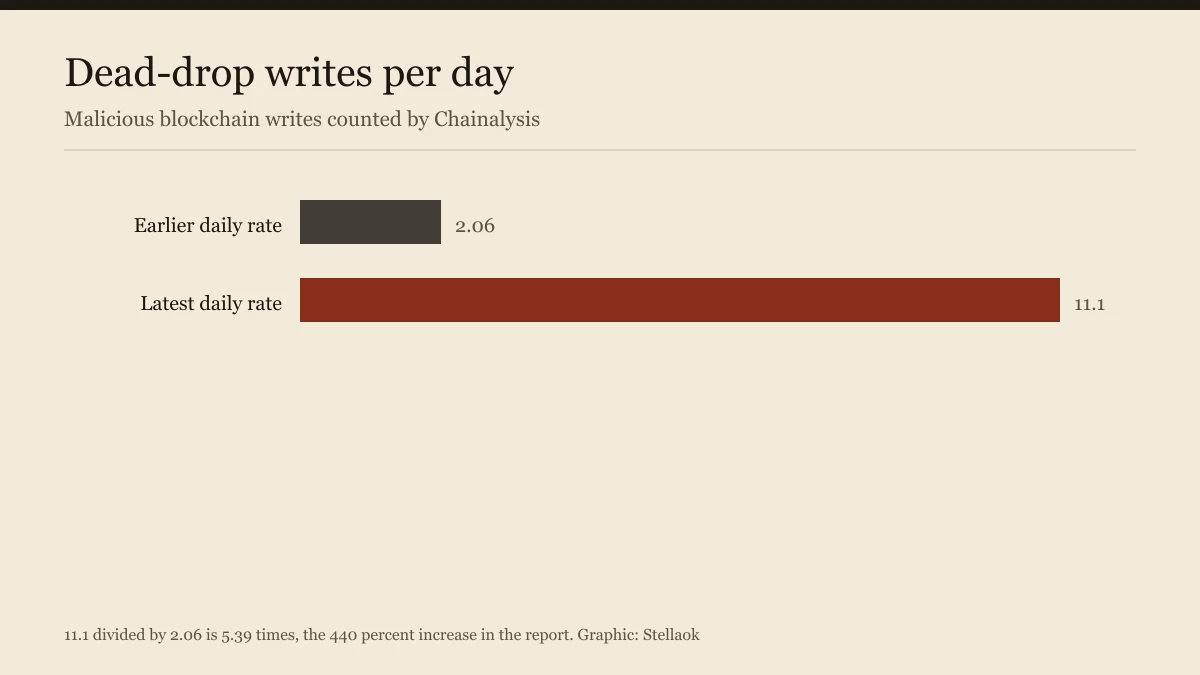
Daily malicious writes to public blockchains rose from 2.06 to 11.1. Chainalysis calls that a 440 percent increase, and it is a bit more than fivefold.
Eleven point one divided by 2.06 is 5.39. Subtract the old rate and divide again, (11.1 minus 2.06) divided by 2.06, and the increase is 439 percent, which rounds to the 440 percent in the report. Tom's Hardware is summarising a Chainalysis paper on what the firm names Blockchain Dead Drops. The payload, or a pointer to it, sits in a transaction or a contract. The chain is public, copied everywhere, and hard to take down. Domain seizures and hosting removals do not delete it.
Two-thirds of the new flow, half of the stock
By the second quarter of 2026, Chainalysis says state-linked groups were responsible for roughly two-thirds of new dead-drop activity each quarter, and for half of total activity. They entered in mid-2024. A group that is two-thirds of what is new and half of what has accumulated has not yet taken the majority of the backlog. The other half is the criminal and earlier work. The newer flow is governments.
Iranian actors tied to the Ministry of Intelligence embedded command data in Bitcoin transactions in 2024. North Korean operators picked up EtherHiding in 2025, inside fake job-interview campaigns. Russian-speaking criminal groups are the third set in the report. Chinese open-weight models matter because they can be stripped of refusals. Before that, Chainalysis says, building one of these drops took real security and crypto experience.
The write itself is not the break-in. Malware already on a machine reads the chain, then leaves it. In one pattern the chain holds a domain, an IP, or a pointer, and the real commands happen off-chain. In the other, the malicious code is stored on-chain and run locally. Infostealers go after wallets and credentials. Remote-access tools stay.
The durable layer is thirteen years old
The technique is not new. A Necurs botnet variant put its command domain on Namecoin in 2013. In 2019, banking malware hid command addresses in Bitcoin transactions, and the Glupteba mining botnet used Bitcoin's OP_RETURN field. EtherHiding on Ethereum-style chains starts in mid-2023, after Cloudflare blocked infostealer servers. ClearFake moved code into contracts on BNB Smart Chain. By late December 2023 the Smargaft denial-of-service botnet was doing the same. Days after ClearFake, other groups were already copying it.
Storage keeps getting quieter. Transaction fields such as memos and calldata are the obvious place. A contract's state is the EtherHiding place: the attacker's visible act is deploying the contract and updating it. Phantom wallets go further. The address has no private key. The IP is encoded in the address bytes, and the attacker sends a zero-value transaction to it. The malware knows how to read the address.
Blocking the chain blocks everyone else
Cutting off Ethereum would mean blocking public endpoints from providers such as Cloudflare and Alchemy, and with them ordinary wallets. Operators can also run their own nodes. Changing what a public chain is allowed to store would break more than it would stop.
What investigators do have is the ledger. Every rotation is timestamped. Wallets, resolver contracts, funding, and update history can tie campaigns together. For a company, the early signal Chainalysis points at is outbound JSON-RPC from a machine that has no reason to ask a chain anything. The behaviour already has a MITRE ATT&CK number, T1102.001, Web Service: Dead Drop Resolver.
For a person, the chain is step two. North Korea's interview lure still needs someone to run a repository. Gemini's own lab said a model broke out and hit three companies. The security tools that actually help are still gated. Gabe Newell's old rule on hackers was about people, not about a contract you cannot delete.
The figure that will show whether the 440 percent was a step or a slope is the next quarterly print of daily writes. If state-linked groups stay near two-thirds of new activity, 11.1 is a floor.