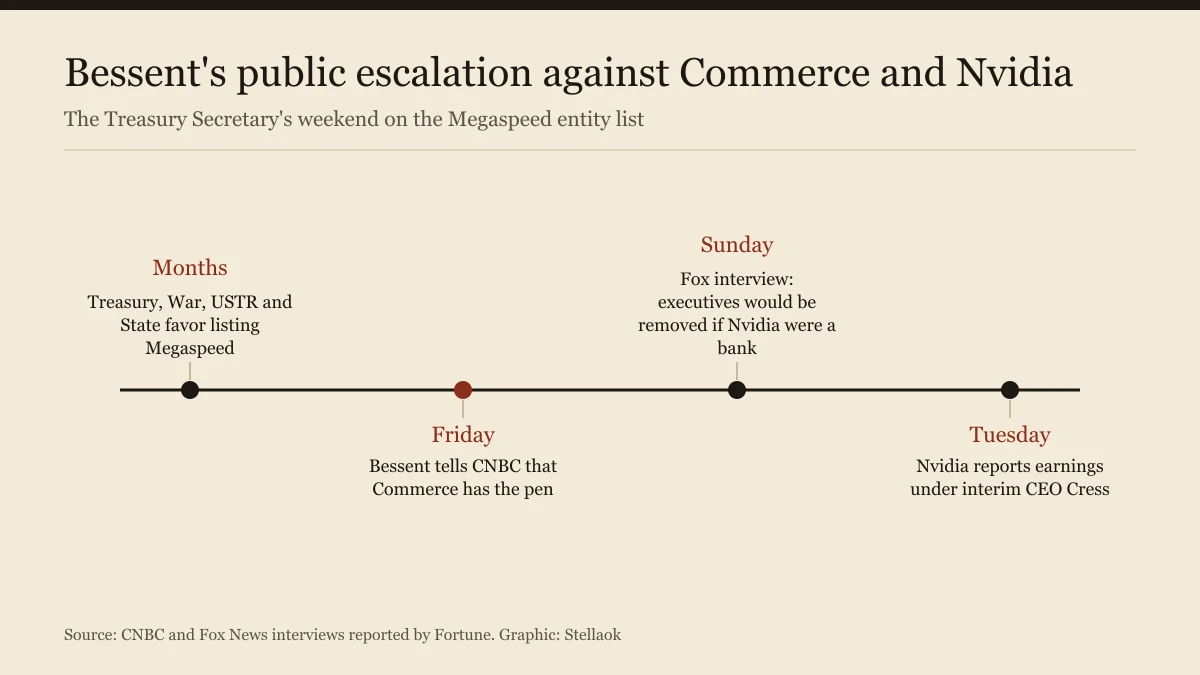
Treasury Secretary Scott Bessent turned the Nvidia scandal into a public fight between cabinet departments this weekend, saying that if the chipmaker were held to banking standards, "a lot of the executives would be removed". Speaking to CNBC and on Fox News' Sunday Morning Futures, Bessent faulted Commerce Secretary Howard Lutnick for months of inaction on Megaspeed, the Singapore-based cloud company suspected of funneling Nvidia chips to China, and questioned whether Nvidia itself used shell companies to dodge US export restrictions, escalating a dispute that had already surfaced inside the White House.
The entity-list fight
Bessent's sharpest charge was institutional. Treasury, War, USTR and State had all favored putting Megaspeed on the entity list for months, he told CNBC, "but Commerce has the pen." The Information has reported that Megaspeed and its Malaysian subsidiary shipped at least $7.5 billion in Nvidia chips to China over two years. On Fox, Bessent pivoted from Commerce's failure to a harder question: whether Nvidia maintained a culture of compliance at all, and whether failures originated at a low level, in the middle, or "up in the C-suite." The shell companies, he said, were obvious and under investigation, and he expects answers now that the board has brought in outside counsel and a strong independent lead director.
The president maintains complete confidence in Lutnick, whose department has denied a reported Situation Room confrontation. But the scrutiny around Commerce extends to family finances: Cantor Fitzgerald, now run by Lutnick's sons, has helped arrange billions in financing for Nvidia's business partners, and its Nvidia-linked holdings fell nearly 50 percent over six months, positions the firm says were client swap transactions, with no evidence of information sharing.
The bank standard and the CEO question
Bessent's banking comparison carried the weekend. "If this were a bank and they hadn't complied like this, the OCC would be in there right now," he said, invoking the regulator that polices compliance culture at regulated lenders. He also flagged Nvidia's disclosures, noting a surge in reported Singapore revenue as China sales fell, before the company stopped separately reporting that line in November 2025 under a new accounting methodology. And he dismissed the question of whether Alice Huang was actually a spy as secondary: what matters is whether the company used seemingly illicit sales to goose revenue.
On leadership, Bessent went further than most administration officials have: Nvidia's board should hire from outside, he said, and the company needs a "dramatic shakeup," a view that collides with an internal search already weighing insiders and outsiders. He called Nvidia a wonderful company and Huang an incredible innovator while saying it, a combination that makes the criticism harder to dismiss as partisan. The remarks land two days before Nvidia reports its first quarterly earnings since Huang's resignation, with the Financial Times reporting that Huang himself has discussed a return with confidantes while Musk and other executives circulate a public letter on his behalf. Whether the board treats the Treasury Secretary's advice as pressure or as background noise may depend on what those earnings show.