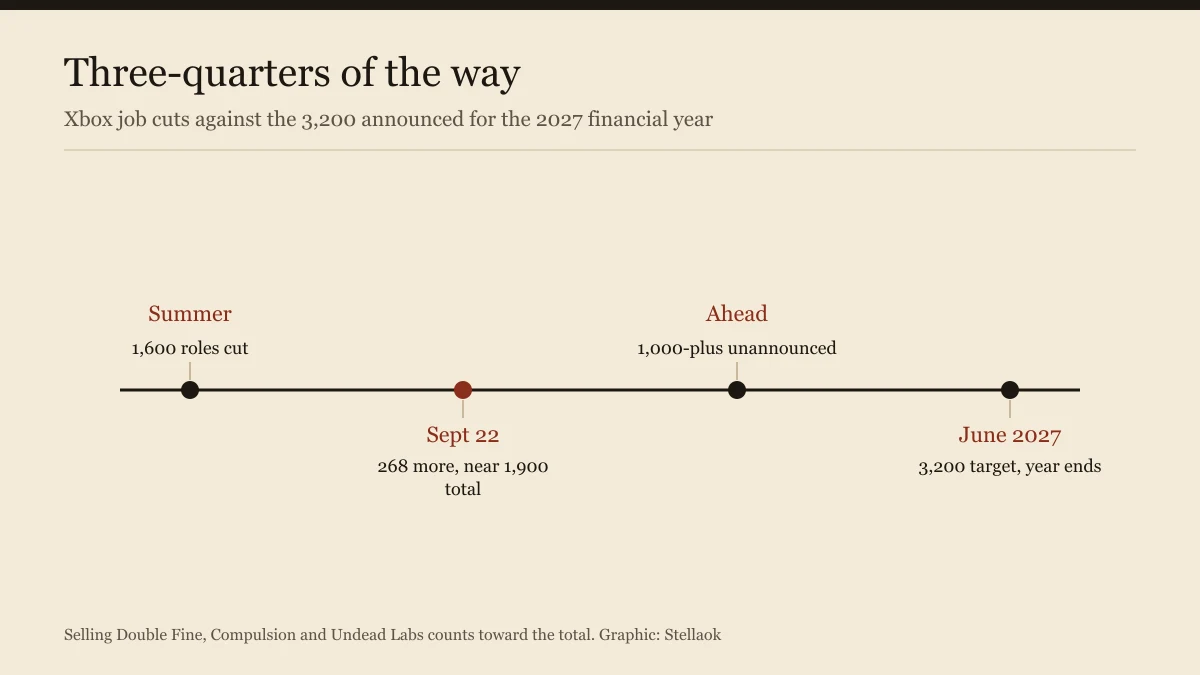
Microsoft cut another 268 Xbox roles today, and the number that matters is the one underneath it. With today's actions and the studio sales that came before them, the company says it is "roughly three-quarters of the way through previously announced restructuring." The target is 3,200 roles across Microsoft's 2027 financial year, which ends in June 2027.
That leaves more than a thousand cuts still to be announced. PC Gamer's breakdown and The Verge's reporting on the memo both put today's total at nearly 1,900 since the 1,600 that went earlier this summer.
Where the 268 came from
Chief content officer Matt Booty's memo names the areas: "Halo Studios, other first-party studios, and the XGS management and central functions layer."
That last phrase is the one Xbox leadership keeps returning to. When CEO Asha Sharma opened this restructuring she called it the most significant in Xbox history and argued that "great technology gets better when it gets simpler, not bigger," blaming redundant management layers that "slowed decisions, blurred accountability, and made it harder to deliver for players."
Three months on, the simplification looks less like removing layers and more like rearranging which studios report to whom. Obsidian is being folded into Bethesda, where it keeps Grounded and the previously announced Fallout project it was already making with Bethesda Game Studios. Playground and Turn 10 are being formally merged into a single studio after, in Xbox's words, more than a decade as "creative and franchise partners," with Forza Horizon and Fable as the combined remit. The casual games unit behind Solitaire, Mahjong and Minesweeper moves from Bethesda to King, which is itself being united with Microsoft Casual Games.
None of those moves reduce headcount on their own. They change org charts.
Ninja Theory is the part with no upside
Four studios were put up for sale as part of the cuts. Double Fine and Compulsion Games have already gone independent, and Undead Labs has moved to new publisher ownership.
Ninja Theory has not. "Unfortunately, two separate agreements for Ninja Theory fell through," Booty wrote. Microsoft is now opening a consultation period on a proposed closure while it says it continues to explore other paths.
Two collapsed deals is information about the market rather than about the studio. A first-party studio with a recognisable output and an owner motivated to sell should be a straightforward transaction, and it was not, twice. Whatever the reason, the practical result is that the developer behind Hellblade is closer to shutting than to a new owner, and a consultation period is what precedes that rather than what prevents it.
Whether the reset produces anything
The stated goal is a smaller, faster Xbox that ships better games. The mechanism is moving franchises to whichever studio has capacity and telling it to deliver.
That is where the internal scepticism sits, and PC Gamer's writer put it plainly: developers inside the company maintain that sustained organisational churn makes quality production harder, not easier. Handing Halo, Fallout and Fable to reshuffled teams on the assumption that enough developers in a room produce a good game is an argument about resourcing, not about craft. Three rounds of restructuring inside a year is also its own cost, because every reorganisation restarts planning, reassigns leads and resets whatever was in progress.
The wider industry has been running the same experiment with different variables. Heart Machine laid off nearly its whole team after a publishing deal collapsed, which is the version of this that happens without a parent company's balance sheet behind it. EA's new Saudi owners have promised not to touch creative decisions, and a lot of players did not find that reassuring. Meanwhile Japanese publishers have largely avoided the layoff wave by never committing to live service, which is starting to look less like caution and more like the only strategy that held.
The next thousand cuts are the ones to watch. Microsoft has a deadline of June 2027 and has told everyone the number, which means the remaining announcements are scheduled rather than reactive. Anyone working at an Xbox studio already knows roughly how many colleagues are still to go, without knowing which.