The argument over whether the past three years amount to a repeat of the 1983 crash has been running for a while, with Brenda Romero saying yes and Tim Cain saying not quite, both having watched the original. Industry analyst Manveer Satvat splits the difference by drawing a line on a map.
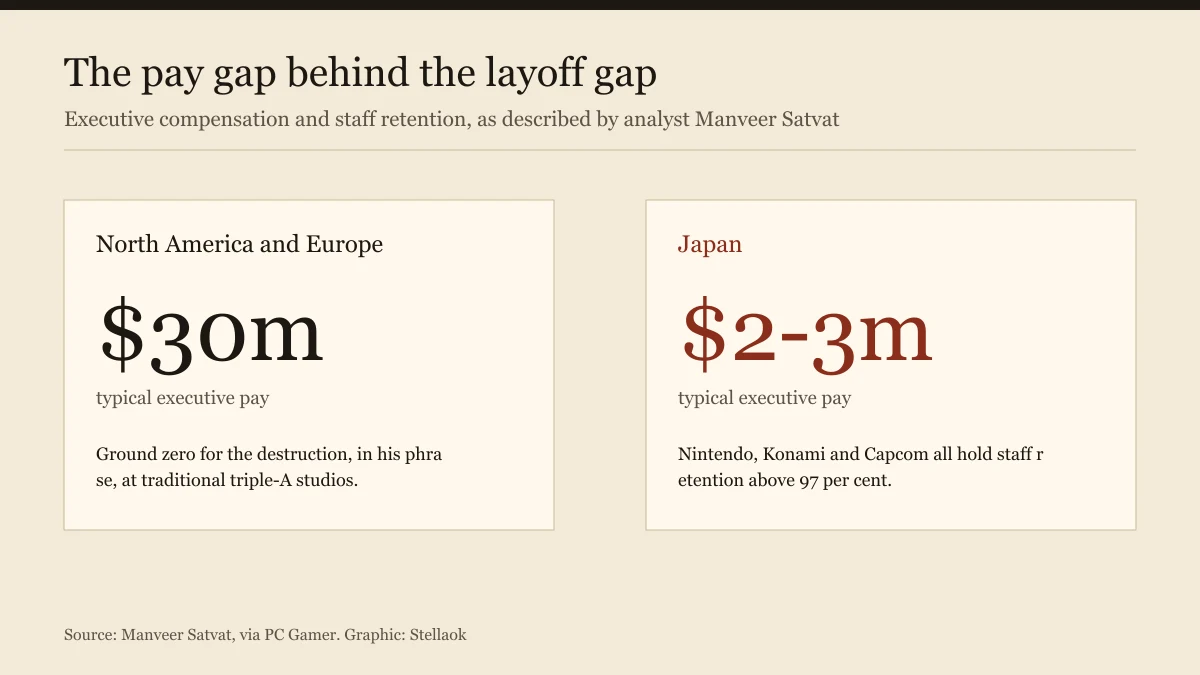
"I think this is as bad as the '83 crash if you're a game developer based in North America or Western Europe, in a traditional triple-A studio," he said. "That is ground zero for the destruction." Then the qualifier: "Japan is a completely different ballgame."
Three structural differences, not a cultural one
Satvat's explanation, laid out in comments picked up by PC Gamer and expanded in a LinkedIn post, has three parts and none of them is about work ethic.
The first is team size. Japanese studios generally build smaller and leaner, which means a project that underperforms does not take two hundred jobs with it. The second follows from the first: "They didn't get swept up in the live-service trend, or into these mega-blockbusters with 500-person teams." A studio that never staffed up for a games-as-a-service pipeline never had to unstaff when the pipeline closed.
The third is the one that travels furthest on social media. "The executive salaries. Japanese executives still make great money, but it's two or three million dollars, not 30 million." Satvat points to retention as the visible result. "Everyone calls out Nintendo, but you can look at Konami or Capcom, these companies all have staff retention of 97%+."
The caveats he includes, and one he does not
Satvat is careful to note that Japanese firms have run mass layoffs in recent years, just nowhere near the scale seen in North America and Western Europe. That matters, because the comparison being drawn is one of degree.
The caveat he leaves out is developer pay. It is not only chief executives who earn less. A 2019 CEDEC survey, discussed in English by consultant Serkan Koto in 2022, put average Japanese developer salaries well below the American equivalent. Any honest version of this comparison has to include that trade: greater job security bought partly with lower compensation, inside a labour market where changing employers is harder and carries more stigma.
Whether that is a better deal depends on which risk a developer would rather carry. A San Francisco engineer on a large salary who has been laid off twice in three years and a Osaka engineer on half that who has been at the same studio for twelve are not obviously ranked.
Why the live-service point is the load-bearing one
Of the three factors, the second explains the most. Live service concentrated enormous headcount into a small number of products that had to succeed at scale or be shut down, and the shutdowns arrived together. Studios that stayed on a release cadence of finished single-player games kept their staffing tied to projects that end rather than to revenue that has to keep growing.
The industry has noticed. Recent output has trended back toward games with a beginning and an end, or toward ongoing work that expands existing worlds rather than replacing them, the way Blizzard is building a Warcraft 3 expansion as a bridge into WoW instead of launching something new that needs its own live team. Even the patch-and-price-cut pattern that carried 007 First Light through its biggest update is a cheaper shape than a permanent service.
The uncomfortable conclusion in Satvat's argument is that none of the Japanese advantages are things a Western publisher can adopt this quarter. Team size is set by the games already in production. Retention is built over a decade. Executive pay is set by boards who will not be cutting their own compensation to save engineers. The structural fix and the structural problem are the same set of decisions, made years ago.