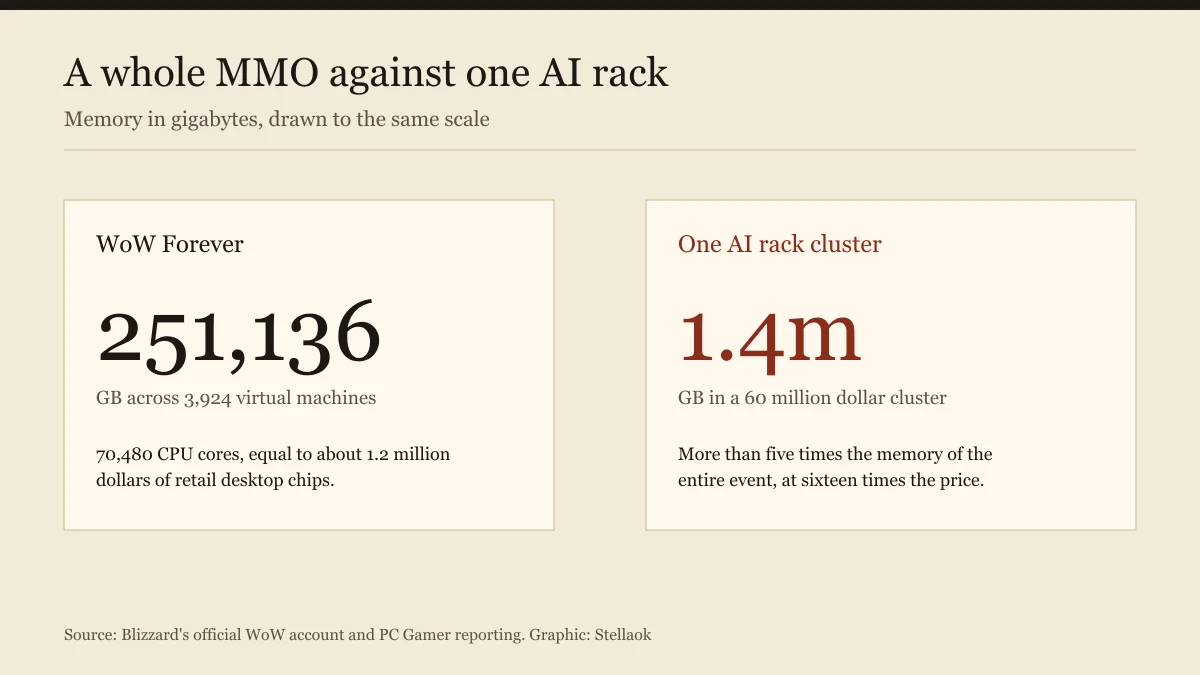
Blizzard published the hardware behind WoW Forever on the game's official account, and the figures are the sort that get passed around because they sound impossible for a video game: about 3,924 virtual machines, 251,136 gigabytes of memory, and 70,480 CPU cores keeping one event online.
Convert the memory and you get roughly 251 terabytes. That is a serious installation by the standards of anything a person runs at home, and it is a rounding error by the standards of the industry that has been buying up every available kilowatt for the past three years.
What the cores actually cost
Price the compute and the number stops being abstract. A cheap six-core desktop chip sells for around $110 today, so 70,480 cores works out to something near $1.2 million if you bought them that way, which no one would. Hyperscalers buy at volumes and amortise over years, and the interesting part is not the sticker price but the ratio: a company with hundreds of thousands of subscribers paying monthly can afford a million dollars of silicon without it becoming a headline.
The 251 terabytes are more revealing. MMOs are memory-resident by design. Every player, every item, every auction listing and every open world state has to be somewhere fast, and the database layer behind a live event is where the budget goes. That is a different problem from training a model, which is why the two workloads do not compete for the same parts in the same way.
One AI rack is sixteen times the price
PC Gamer has reported on an AI rack cluster that cost $60 million and carried about 1.4 petabytes of memory, or 1.4 million gigabytes, with roughly 4,200 CPUs. On memory alone that single cluster holds more than five times what WoW Forever uses. On cost, a billion dollars buys about sixteen of them.
Put the two side by side and the comparison says less about Blizzard than about the scale of the buildout. Microsoft alone spends multiple tens of billions a year on AI capital projects. The entire server estate for one of the largest online games in the world is a line item inside a single month of that spending.
That imbalance is now visible in the supply chain. Memory makers have been redirecting capacity toward data centre parts, a shift we covered when Macronix left game cartridges to make memory for data centres, and the same demand has pushed compute plans into the gigawatts, as with SpaceX's ten gigawatt target for 2027.
Why the number is worth publishing
Blizzard did not have to share any of this. Studios rarely publish server topology, because it invites second-guessing and tells competitors something about capacity planning. The post reads as a flex aimed at players who complain about lag during a time-limited event, and it works: 3,924 virtual machines is a concrete answer to "why did the queue take twenty minutes."
For players, the useful takeaway is that a live game's performance is a capacity decision made months earlier. For everyone else, the number is a reminder that the biggest entertainment events on earth now run on infrastructure that would barely register as a tenant in an AI data centre. That is not a criticism of the game. It is a measure of how far the other side of the industry has moved.