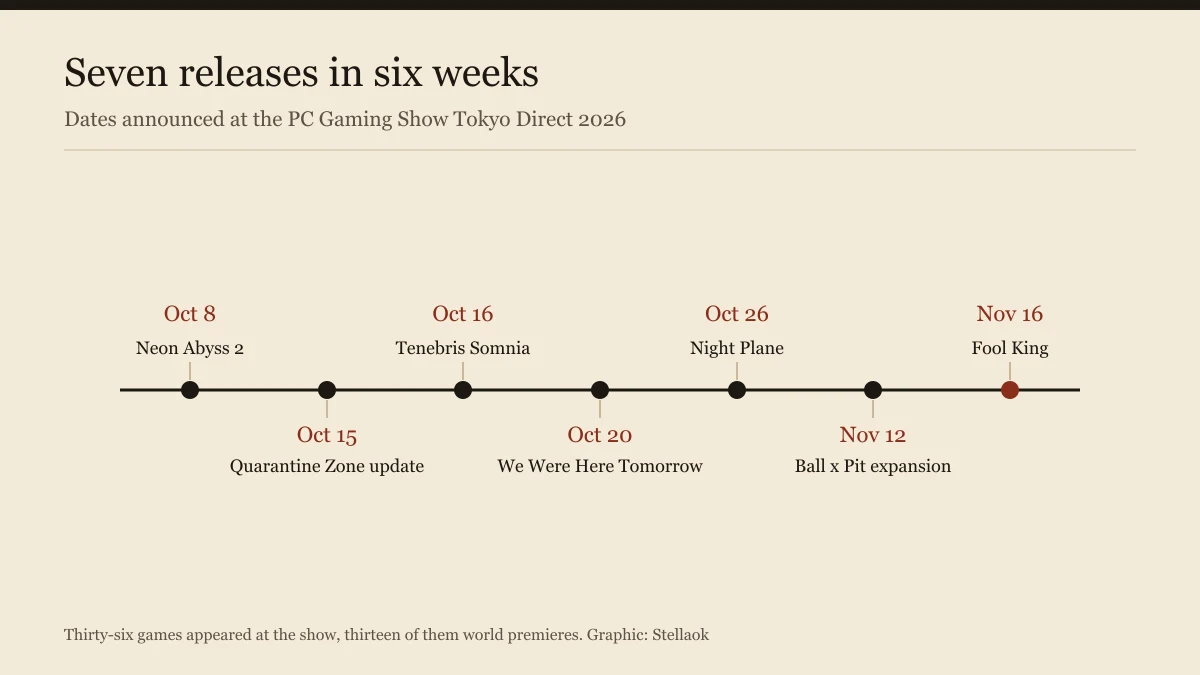
The PC Gaming Show Tokyo Direct returned with details on 36 games and their DLC, including 13 world premieres. That is a normal size for one of these broadcasts. What is not normal is the calendar it produced.
Going through PC Gamer's rundown of the show in order, seven of the games and updates that got firm dates land between October 8 and November 16. Neon Abyss 2 on October 8. Quarantine Zone's free Miami Zero update on October 15. Tenebris Somnia on October 16. We Were Here Tomorrow on October 20. Night Plane on October 26. The Ball x Pit expansion on November 12. Fool King on November 16.
Six weeks, seven releases, one audience
These games are not competing for the same players in every case, but several of them are. Neon Abyss 2, Ball x Pit and Fool King all want the same run-based, mechanically dense attention span. Tenebris Somnia and Night Plane are both horror, both dated ten days apart, both aimed at Halloween.
That is what a showcase schedule looks like when everyone is optimising for the same seasonal window. October is where horror sells, and the run-up to the Steam autumn sale is where wishlists convert. The cost is that a game landing on October 20 has roughly four days of visibility before the next one arrives.
The two that gave themselves room are the ones that need it. Let's Build a Dungeon, where you run a studio and build the MMO it is making while players leave bad reviews, goes to early access on February 11, 2027. Vaewolf, an action game whose protagonist is part werewolf, part vampire and part elf, is aiming at early 2027. Stronghold 4 is the vaguest, promised for later this year, which for a castle sim series returning after 15 years without a numbered entry is either confidence or an unfinished build.
The premieres worth noting
Lufia 1 & 2 The Sinistrals Saga is the one with actual scarcity value. It brings the first two games in the RPG series together in one package and is their first official PC release, which for a series with this much residual affection is a straightforward proposition.
Really Illegal Golf is the show's best pitch in one sentence: break into places you are not allowed to be so you can play a round of golf, sneaking past guards and cameras or tasing anyone in the way. A demo is on Steam already.
Tenebris Somnia is doing something more unusual. It mixes a retro 2D presentation with live-action cutscenes shot by an award-winning Argentine film crew using practical effects wherever possible. Live-action horror has a long history of going badly, and a team that chose practical over digital has at least thought about why.
Hodka is a van and an open world in the fog, with no date. Piroker is pirates plus poker plus relics, currently taking playtest signups. Quarantine Zone's update moves its checkpoint-and-contagion loop to Miami, with a trailer that invites you to experiment with drugs.
Ball x Pit's expansion is the most specific about content: 20 new ball evolutions, eight new hunters, four new biomes, 20 new buildings and 46 new passives.
The format is now a wishlist funnel
Nearly every entry in the rundown ends the same way, with an instruction to wishlist on Steam or download a demo. That is not a criticism of the show so much as a description of what it is for.
Steam wishlists drive the visibility a launch gets, which drives the front-page placement, which drives the sales. A showcase in the week of the Tokyo Game Show exists to convert a broadcast audience into wishlist numbers before a release window opens. The publishers know it, the developers know it, and the shows are built accordingly, with demos available the same day so the conversion happens while attention is still there.
The problem is throughput. With 36 games in one broadcast and comparable events running through September, the volume outpaces what anyone can track, and good games disappear into the announcement pile without anyone deciding they should. Seven dated releases inside six weeks compounds it.
Worth noting where this show sits geographically. A Tokyo-facing PC showcase carrying this many Western indie games reflects a market that has been unusually stable lately, with Japanese studios having avoided the layoff wave by never committing to live service. The audience is there, and the games are increasingly being aimed at it directly rather than through a domestic publisher.