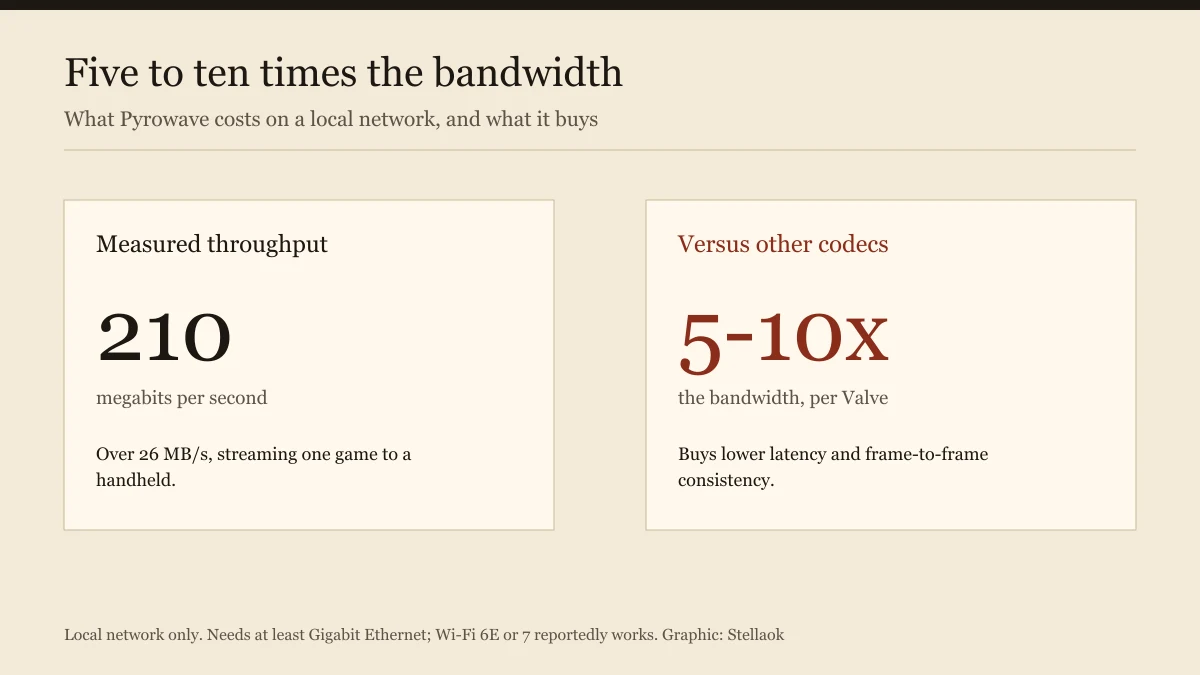
Valve has added a codec to Steam Remote Play that trades bandwidth for everything else. In a test streaming Phantasy Star Online 2: New Genesis from a desktop to a Lenovo Legion Go S, Tom's Hardware measured Pyrowave at around 210 megabits per second on default settings. That is over 26 megabytes a second, continuously, to play a game in another room.
Valve's own beta patch notes put the cost at "5-10 times the amount of bandwidth of other streaming codecs." What you get back is latency and image quality, and the reason is architectural rather than incremental.
Why it is fast
Conventional codecs like AVC and AV1 achieve their compression with tricks. The most relevant one here is chroma subsampling, which spends less data on colour than on brightness because human vision is less sensitive to it. For most game content that is invisible. On a desktop, or in a game with a lot of text and fine detail, it produces fringing that makes text genuinely harder to read. The fix is 4:4:4 video, which common video codec hardware supports poorly.
Pyrowave, written by Arntzen, sidesteps both problems by working differently. Instead of Discrete Cosine Transforms and inter-frame encoding, it uses Discrete Wavelet Transforms and encodes each frame independently, which puts it closer to Motion JPEG2000 than to a modern video codec.
That choice has consequences in both directions. Encoding every frame on its own means no frame depends on the one before it, so quality stays consistent from frame to frame and errors do not propagate. And because the algorithm is simple enough to run on the GPU's shader array rather than the fixed-function video engine, which does not understand it, the latency is very low and the capabilities of the encode hardware stop mattering.
The cost of throwing away inter-frame encoding is that you transmit a lot more data, which is the 210 megabits.
The bandwidth number in context
Tom's Hardware's framing is the right one: 210 megabits per second sounds enormous on a network and is trivial next to what a graphics card already does. Your GPU sends tens of gigabytes per second to the monitor over DisplayPort. Pyrowave is a rounding error against that.
It is not a rounding error against a home network. Valve is explicit that this is for your local network and not the internet, which means two useful things. Your broadband speed is irrelevant, and there is no risk to a metered data allowance, because none of the traffic leaves the house. It also means Pyrowave can disrupt everyone else on the same LAN, which is why it is unsuitable for an office or any high-traffic network.
Requirements are at least Gigabit Ethernet according to Valve, though user reports in the Steam discussions say a solid Wi-Fi 6E or Wi-Fi 7 link handles it.
Whether it is worth switching on
The tester's verdict was that it felt tangibly more responsive than standard Remote Play, and that image quality was exceptional once 4:4:4 mode was enabled. The unresolved question is GPU overhead: the test ran on an RTX 5070 Ti with streaming capped at 120 FPS, which was not enough load to find the ceiling.
That matters because the shader array doing the encoding is the same hardware rendering the game. On a high-end card with headroom, the cost is invisible. On a card already at its limit, a codec running in the shader path competes with the frames you are trying to stream, and nobody has published numbers for that case yet.
To try it: switch to the Steam beta client, then find Pyrowave in Remote Play settings. It covers standard games on macOS, Windows and Linux, not VR, with Valve saying the Steam Link mobile app is coming.
The direction of travel here is consistent with what Valve's engineers have described elsewhere about Steam Frame, standalone streaming and SteamOS on Arm: treat the local network as the transport and put the work wherever there is silicon to do it, rather than waiting for fixed-function encoders to catch up. It is also the kind of long-horizon platform work that has kept the store's technical decisions unusually stable, in the way Gabe Newell's rule about hackers has held up for two decades.