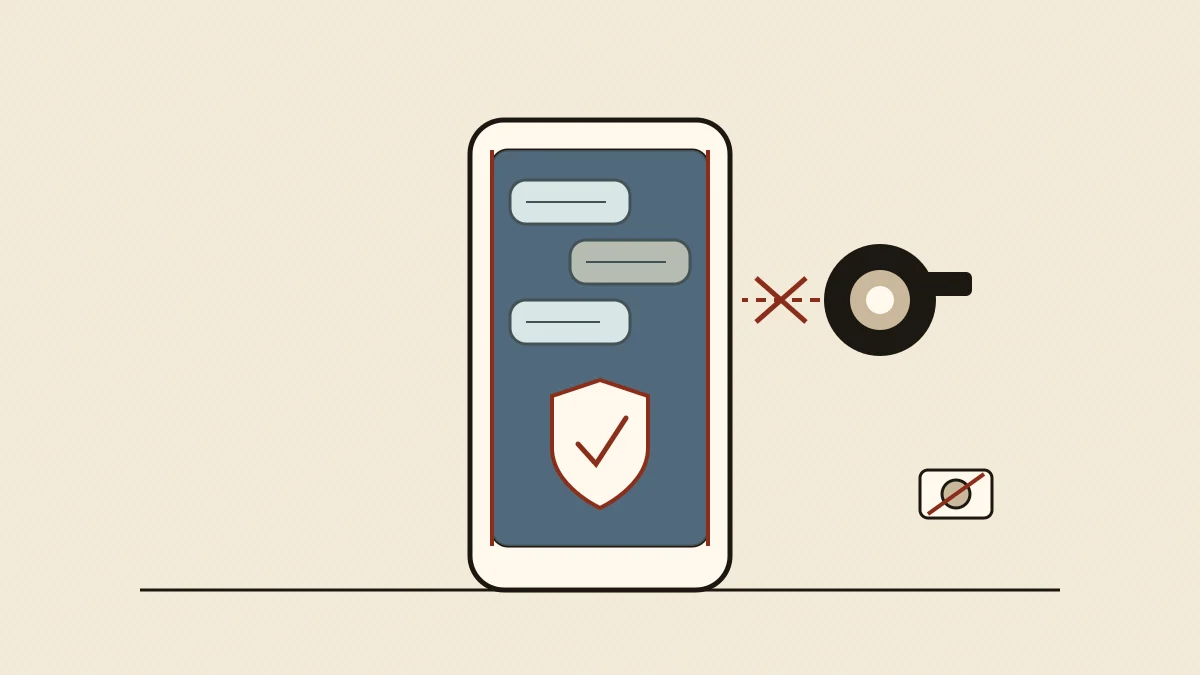
Signal will stop people from taking screenshots of chats by default, its president Meredith Whittaker said in a blog post on Friday. The setting applies to the iOS 27 version of the app and to any attempt by an AI assistant to capture screen data on Android. Users can switch the block off, though the company advises against it.
The trigger is the arrival of assistant features that live inside the operating system. Whittaker named Google's Gemini Intelligence and Apple's Siri AI, whose onscreen awareness lets an assistant read what a user is looking at so it can act on a request. Once that layer exists, a secure messenger is no longer the only program that can see its own messages.
"Your sensitive data is being captured, stored, and made accessible to whatever local database or remote server an OS-level AI agent is using at that moment," Whittaker wrote. She said the capture happens outside Signal's control and endangers everyone in a conversation, including the person who never installed an agent.
Encryption does not cover what is on the glass
Signal's guarantee has always stopped at the endpoints it controls. Messages are scrambled in transit and stored encrypted on the device, so an interception in the middle yields nothing readable. A screenshot skips all of that. The phone has already decrypted the message in order to draw it, and anything that can observe the drawn screen gets plain text.
John Strand, chief executive of Black Hills Information Security, put the same point to CNET: reading a message requires decrypting it, so an agent that can see the screen "can read those messages without ever having to break the encryption itself." The worst case he described is an attacker, or an agent acting on an attacker's instructions, watching everything a user sees, passwords included.
Signal has made this move before. Last year it blocked screenshots of Signal chats on Windows 11 to keep Microsoft's Recall feature from storing them, back when Recall was a local screenshot archive rather than an assistant. That fix covered one desktop. The new one tries to cover two mobile platforms at once, which is why the company frames it as a policy question rather than a feature.
Agents inherit permissions nobody audited
The timing is not accidental. A Reuters investigation published this week, supported by Signal and the AI Now Institute, found that Meta's Muse agent used permissions granted during setup to reach apps and data the user had never connected. Our report on that case traced how an assistant with broad access can act on accounts it was never pointed at.
Whittaker argued that app developers have no reasonable tool to prevent this. Even where Signal can detect and block an agent's access, she said, Google, Apple and Microsoft give developers no way to restrict it without wrecking the ordinary experience of using a phone. The same gap is why Signal says it cannot yet ship the protection on macOS.
Her asks are modest: a documented description of how each platform's agent works, and an opt-out that developers can invoke. Apple and Google did not respond to requests for comment.
What users actually get
In practice, the change means screenshots inside Signal stop working unless someone goes into settings and turns them back on. Whittaker warned that doing so exposes the user's messages and those of everyone they talk to. Blocking the capture also stops the ordinary reasons people screenshot a chat, from saving an address to keeping a receipt, so the app is trading convenience for a threat that most users cannot see.
The wider argument about agent mistakes has so far been settled in favor of the companies deploying them, with customers carrying the loss when an agent does something wrong. Signal is taking the opposite position: if the platform will not draw a line around a private conversation, the app will draw one itself, even a partial one.
There is a real limit to that. Whittaker conceded that an agent might still reach Signal's data through the file system, where a copy already exists. A blocked screenshot raises the cost of grabbing a conversation. It does not make the conversation invisible to a program that has been given the run of the device.