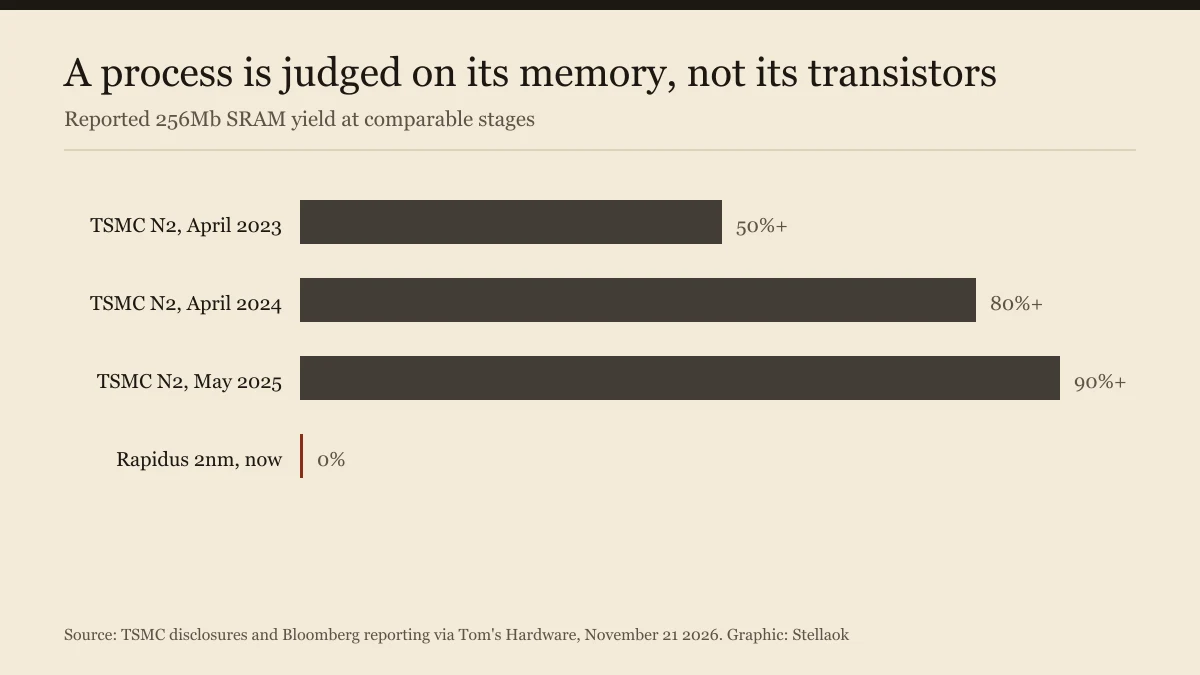
Rapidus has not yet produced working SRAM cells on its 2nm-class process, according to Bloomberg, missing a milestone it was expected to clear this summer. The report, summarised by Tom's Hardware, also says the company is fighting contamination inside its cleanroom in Hokkaido. Both problems put the government-backed foundry's plan to start mass production in 2027 at risk.
The company has been the most visible attempt to rebuild leading-edge chip manufacturing in Japan. It was founded in 2022, licenses process technology developed by IBM, and is funded largely by the state, with the IIM-1 facility built to take on work that TSMC and Samsung now dominate.
Rapidus has shown that the basic building block works. In July 2025 it produced test structures using 2nm gate-all-around transistors, and chief executive Atsuyoshi Koike told the Hot Chips conference that month that the company had "successfully obtained electrical characteristics of 2-nanometer node GAA transistors."
A working transistor is not a working chip. SRAM is where that gap shows up.
Why memory cells come before logic
Static random-access memory is the cache inside every processor, and a single die can hold hundreds of millions of cells. The standard cell uses six transistors: four wired into two cross-coupled inverters that hold a bit, and two that control access to it. Add the contacts, the local interconnects, the wordlines and bitlines, the sense amplifiers and the decoders, and a 256KB block becomes a complicated integrated circuit in its own right.
That repetition is exactly why fabs use SRAM to qualify a process. A regular array of identical cells exposes defects, transistor variation and yield problems that a handful of test transistors will never reveal. If the memory cannot be built reliably, logic built on the same rules will not be either.
TSMC publishes its progress in these terms. Its N2 process reported more than 50% yield on a 256Mb SRAM test chip in April 2023, more than 80% by April 2024, and above 90% in May 2025, about half a year before mass production began. Rapidus has not published an SRAM figure. According to Bloomberg, its yield on functioning cells is zero.
The physics is unforgiving
Gate-all-around transistors stack silicon nanosheets vertically and wrap the gate around them, which improves control of the channel but adds steps. One of the hardest is removing the silicon-germanium layers that separate the sheets without thinning or roughening the silicon left behind. Etch too little and material stays between the sheets; etch too much and the channel is damaged.
EUV lithography adds its own failure mode. At these dimensions, the random behavior of photons and resist chemistry produces variation in feature size, rough edges, and occasionally a missing or malformed structure. A single transistor can pass a test while a circuit with millions of connections fails on one of those defects. The inner spacers that isolate the gate from the source and drain are similarly sensitive to small etch variations.
Only Intel, TSMC and Samsung have started mass production on nodes that use gate-all-around devices. Rapidus is trying to reach the same point from a standing start, in a new fab, on a process it did not invent.
The calendar is now the problem
Rapidus has said it will begin mass production in the second half of fiscal 2027, which ends on March 31, 2028. Earlier statements referred to 2027 without specifying a fiscal year, which readers took to mean the calendar year.
Before high-volume manufacturing, a foundry has to show functional cells, integrate them into larger arrays, reach acceptable yields, qualify the process and run risk production about a year ahead of the ramp. Each of those steps depends on the one before it. Intel has been running the same qualification race on its 18A node, and TSMC's roadmap is already shifting customers toward N2X.
Rapidus has not confirmed any delay, and the contamination report has not been addressed publicly. What the company has is a working transistor, a nearly finished fab and a customer list it has not disclosed. What it does not have, yet, is memory.