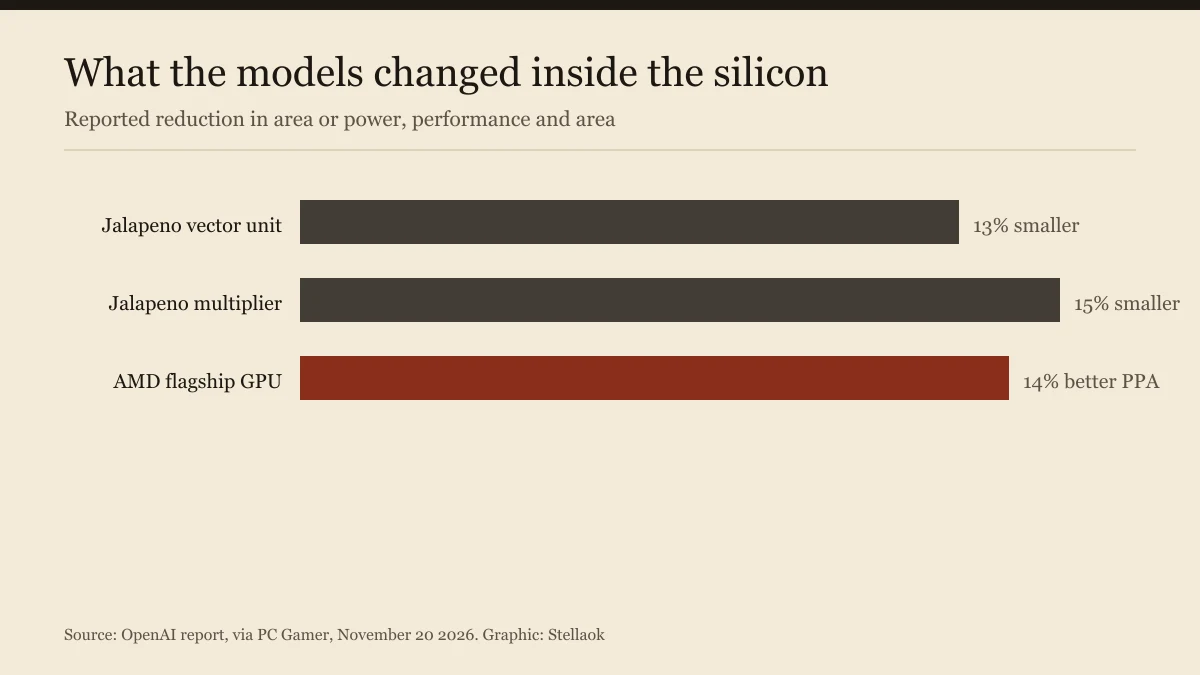
OpenAI says its models rewrote parts of AMD's chip designs and produced improvements of up to 14% in power, performance and area, a measure chip engineers shorten to PPA. The company described the rewrites as production-viable, and PC Gamer reports that AMD has already used some of the changes in designs that have gone to manufacturing.
The work covered three targets: an in-house OpenAI chip code-named Jalapeño, an AMD flagship GPU, and key modules of AMD's next-generation flagship CPU. Each produced a different result. For Jalapeño's vector compute unit, the models cut cell area by roughly 13%, a figure OpenAI says it confirmed when the hardware was powered on. On the same unit, standard cell area fell about 10%, the multiplier area alone dropped around 15%, and latency went from two clock cycles to one.
The AMD GPU took the headline number, a 14% PPA gain. AMD has reportedly verified a single-digit PPA improvement on the CPU modules.
A year of tuning in five months
OpenAI's claim is not that a human team could never find these changes. It is that the models compressed roughly a year of design optimisation into under five months. The report tested four models, GPT-6.2 Astra, GPT-6 Astra, GPT-6.1 Sol and GPT-5.6 Sol, working with a budget of about 112,000 tokens.
One finding cuts against the obvious next step. Asked to design a RISC-V core from scratch, every model did better than when asked to optimise a core it was given. Starting clean produced stronger results, and also a risk: a model that redesigns rather than adjusts can quietly drop features the original needed. That is a failure mode chip teams cannot ship, since a missing instruction is not a rounding error.
Silicon is becoming a text problem
The result lands in a market where design time is a competitive weapon. Anthropic made a similar claim this week about bringing up AMD accelerators quickly, and every large lab is now trying to shorten the loop between a model and the hardware it runs on. Chip design is unusually suited to the attempt because so much of it reduces to verifiable rules: area, timing, power and function can all be measured, which means a model's proposal can be checked rather than trusted.
That is also the difference between this and the usual AI productivity pitch. A generated paragraph is judged by a reader. A generated circuit is judged by a power-on test, and OpenAI says it ran one.
There is a cost side that the report does not settle. AI tools that search for bugs are generating more work than the engineers who have to triage them, and Linux kernel developers have said publicly that they are struggling with the volume of reports machine analysis produces. Design automation may add a similar queue inside chip companies, where a saved month of layout work can turn into a month of review.
What it means for buyers
For anyone outside the two companies, the near-term effect is indirect. AMD gets design improvements it did not pay a design team for, OpenAI gets a reference case for selling the same service to other chipmakers, and Intel's foundry business gets one more argument that the value in silicon is shifting toward whoever can iterate fastest.
The number to watch is not the 14%. It is whether the next AMD generation ships on the schedule it would have kept anyway. If it does, the models made the design cheaper. If it slips, they did not help where help was needed.