Electronic Arts announced an advertising platform in June that lets brands market directly inside its games, and the first six months of it explain why the rest of the industry is watching. The pitch is that the ads will be the kind already in the games, such as pitch-side boards in EA Sports FC, rather than anything that interrupts play. GamesIndustry.biz asked analysts what the business actually looks like, and the answer is a publisher deciding to stop renting out its audience through someone else.
The intermediary is the point
Louise Wooldridge, senior research manager at Ampere Analysis, reads EA Advertising as an attempt to bring the ad network in-house. Third-party networks such as Anzu and Bidstack typically take more than 35 percent of ad spend, and a platform owned by the publisher keeps that margin. The inventory behind it is large: Ampere's title data shows EA Sports FC alone was played for almost 5 billion hours across PlayStation, Xbox and Steam in 2025, with average monthly active users of 23 million.
At that scale, Wooldridge estimates the sports franchises hold a pool of ad inventory worth hundreds of millions of dollars a year. That figure is an estimate rather than a booked number, but it is the reason other publishers are running the same arithmetic. Development budgets keep rising and the subscription and storefront lines have flattened, so advertising is one of the few revenue streams that scales with audience rather than with price.
The debt clock behind the strategy
The timing is not only about margins. EA is servicing roughly $1.8 billion a year in interest on the debt taken on for its acquisition, according to reporting cited by GamesIndustry.biz, and Aldora founder Joost van Dreunen argues the company has hit the ceiling on its addressable audience. Growth from here has to come from extracting more per player rather than from finding new ones.
That framing matters for how the rollout will go. A publisher that needs revenue growth has an incentive to expand ad formats once the first version is accepted, and the history is not encouraging: in 2020 EA removed adverts from UFC 4 after a backlash, because those ads ran in the middle of action replays. The current pitch is deliberately narrower, with static boards rather than video breaks, but the same company is doing the selling.
Microsoft is testing a different trade
Xbox's experiment, announced in July, is advertising as an access tier rather than as a revenue layer on top of a purchase. Players can stream games they already own for free if they watch an ad before the session starts. An Xbox spokesperson told GamesIndustry.biz the test is about making games more accessible, and the company has published five principles: start with the player, ads should create value, do not interrupt gameplay, hold ads to the quality of the content, be clear about what is advertising, and fit each platform's expectations.
That is a cleaner value exchange than the one EA is proposing, because the player gets something measurable in return. It is also a smaller business, since it only touches the streaming catalogue. Wooldridge argues the consumer resistance risk sits higher for Microsoft, precisely because the model changes what the player pays, while EA's version asks only that a board on a pitch change its logo.
What the data says players tolerate
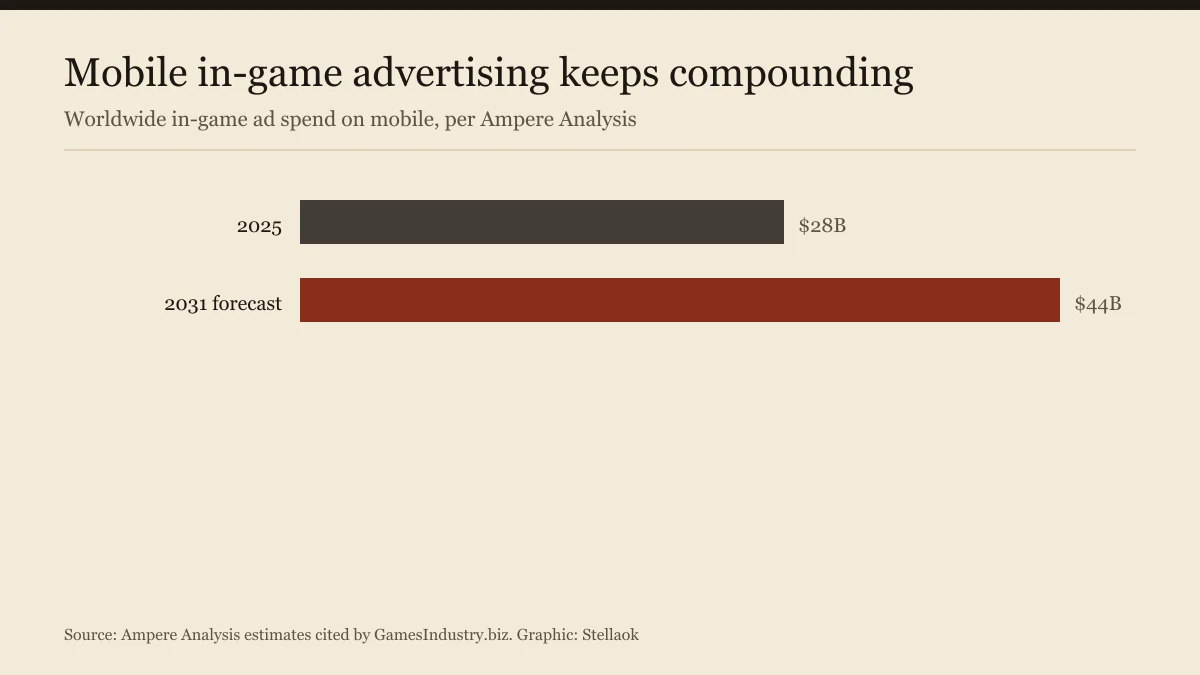
The market these companies are moving into is mobile first. Ampere puts in-game advertising on mobile at $28 billion in 2025, rising to $44 billion by 2031, at which point it would rival the size of today's console games and services market. Console and PC have resisted that model because players paid upfront, and an ad on top feels like a second charge on something already bought.
Deloitte's research offers the more useful number for the argument: one in five players said they would play a title more often if in-game ads were high quality, while a fifth said they had quit a game over a poor ad experience, and playable ads with disruptive features doubled the odds of quitting. High quality here means the Football Manager approach, where advertising hoardings sit where a real stadium would have them. EA's reputation for monetisation is the constraint on how far it can push, and its new owners have already had to answer questions about how much they will interfere with the games themselves. The first test of the ad network will be whether a publisher with that history can sell a billboard without selling the interruption that goes with it.