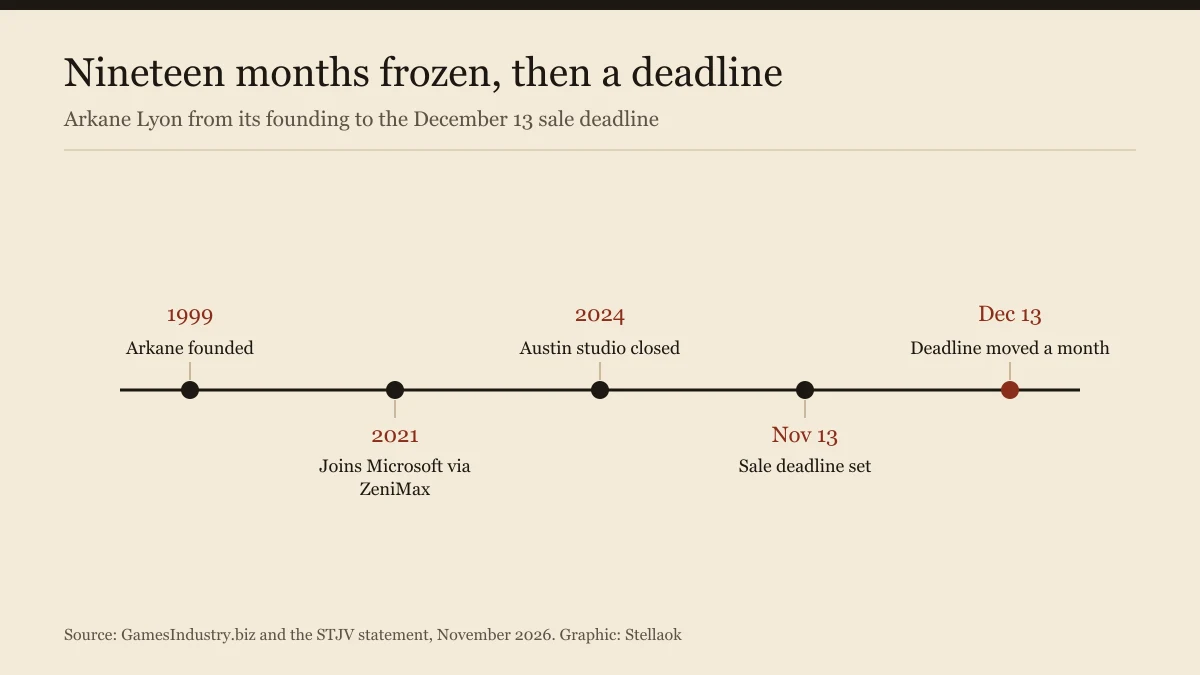
Arkane Lyon's union has accused Microsoft of causing the problems it now uses to justify closing the studio. In a statement published on Wednesday, the STJV said a 19-month hiring freeze produced delays and extra cost on Marvel's Blade, and that Microsoft is citing those same delays and costs as its economic case for shutting the studio down. PC Gamer reported the claim, and GamesIndustry.biz carried the union's numbers.
The union's account of the game itself is positive. It says work on Blade is going fine and that the quality is in line with the Dishonored series and Prey. That claim matters because it removes the usual explanation. If the game is not in trouble, then the reason for closing the studio has to be something other than the game.
The freeze is the evidence
A hiring freeze is a quiet instrument. It does not produce a memo, a round of interviews or a number anyone can check, and it does not stop work. It slows work, in the specific places where a team is waiting for a specialist, and the delay it creates shows up months later as a schedule slip that looks like a development problem.
The union's argument is that Microsoft controlled the freeze, observed the slip, and then treated the slip as a fact about the studio rather than a fact about its own decision. "Microsoft is actually why those economic reasons even exist," the statement says. Microsoft has not responded to the claim.
There is a version of this that is not sinister and is still the same outcome: a company decides a studio is not core, stops investing in it, and the resulting slowdown becomes the evidence for the decision already made. Whether that is strategy or sabotage depends on intent nobody outside the room can see. What is observable is the sequence, and the sequence runs freeze first.
Arkane's position in the wider cuts is not unusual. Xbox is three quarters of the way through 3,200 job cuts, and the same restructuring opened an XP division while studios were being trimmed. Funcom went through a similar round this autumn, cutting staff while narrowing to the two games it already runs.
What the union wants, in numbers
Arkane Lyon has 217 staff, plus contractors and freelancers. Microsoft set a November 13 deadline for a sale and then extended it by a month to December 13, which is the clearest signal that a buyer is being sought rather than assumed.
The demands are specific. Workers should have a say in choosing any buyer. A fund should protect staff who are laid off by a new owner within two years. If the studio closes, the union wants 200,000 euros per worker, about $223,000, plus two years of Microsoft-funded redeployment support. Multiply the per-head figure by the 217 staff and the redundancy bill alone comes to roughly $48.4 million.
For scale, Microsoft reported net income of $36.6 billion in the first quarter of its 2027 fiscal year. The entire redundancy demand is about 0.13 percent of a single quarter's profit, which is the union's point: the money is not the constraint. It describes Arkane as profitable, just not profitable enough for the parent company, and argues that closing now would cost more than letting the team finish the game.
A buyer is the only path that keeps the studio
Ubisoft is reportedly interested in acquiring Arkane Lyon, which would keep the name and most of the staff while changing the owner. Ubisoft is in the middle of its own reorganisation into six creative houses, so the interest is not obviously comfortable: a company cutting costs is not the natural home for a studio that needs to finish an expensive licensed game.
Arkane was founded in 1999 and joined Microsoft through the ZeniMax acquisition in 2021. Xbox closed its Austin studio in 2024, which means Lyon is the second Arkane site to face closure in three years and the only one still making a game under the name.
The deadline to watch is December 13. If a sale completes, the argument about who caused the delay becomes history. If it does not, the union's demand lands on a company that has already decided the studio is not worth keeping, and the test becomes whether Microsoft pays above the legal minimum to close a studio it says it cannot afford to keep open.