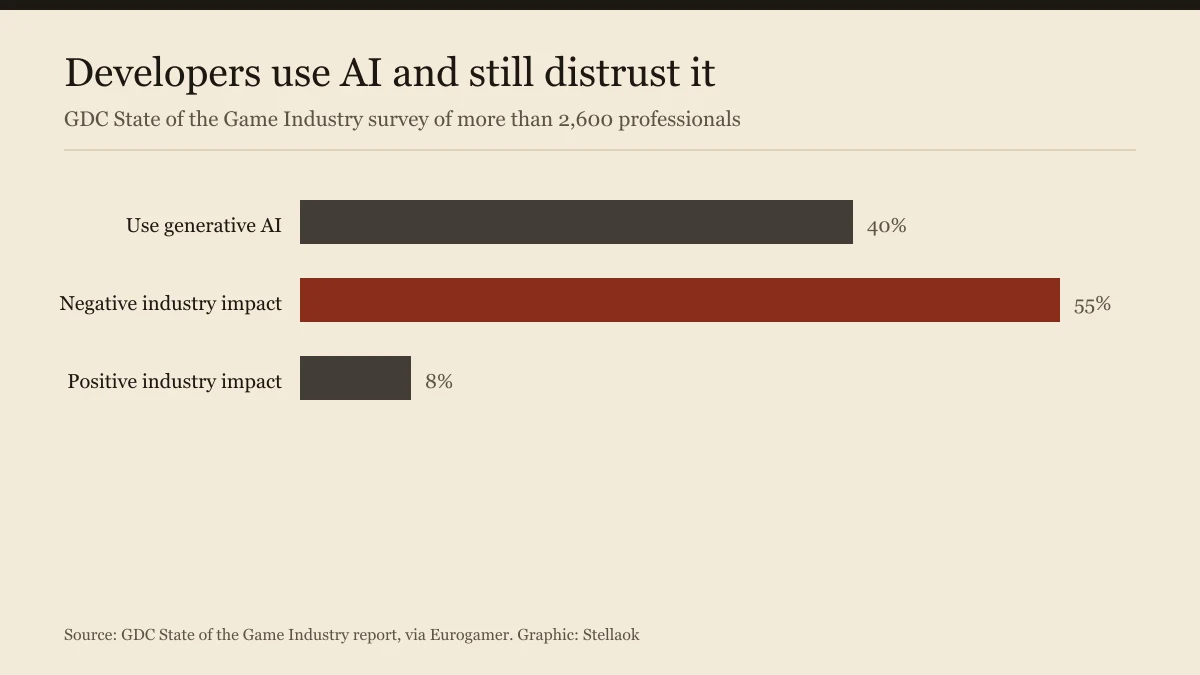
The Game Developers Conference has published its latest State of the Game Industry report, and the two headline numbers point in opposite directions. Forty percent of developers surveyed say they now use generative AI in their work, up from 36 percent a year earlier. Fifty-five percent say the technology is having a negative effect on the games industry, a figure up 25 points since 2025 and one point since the start of 2026. Only 8 percent see a positive impact, with 35 percent calling it mixed.
The survey covered more than 2,600 respondents across the industry, and PC Gamer's report came via Eurogamer. One caveat worth flagging: GDC used AI sentiment analysis tools to process some responses, a choice the report itself discloses.
Who uses it, and for what
The usage profile is uneven. Professionals over 45 are more likely to use the tools, at 54 percent, men report higher usage than women, and indie developers trail studios working on premium, free-to-play and mobile games. Whatever one thinks of the technology, avoiding it is getting harder; even a routine web search now returns AI-generated answers by default.
What people actually do with it is telling. Among users, nearly three quarters say they use generative AI for research and brainstorming, and 56 percent for code generation and debugging. The creative end of the pipeline is a different story: 22 percent use it for concept art or visual ideation, and just 7 percent for player-facing features. Developers seem comfortable letting models help them think and fix, and much less comfortable letting them face the player.
The sentiment problem
The report's own conclusion, processed with that AI sentiment tooling, is that professionals are "forming more nuanced views on generative AI, rather than taking an all-or-nothing stance." The nuance cuts both ways. New concerns include skill atrophy and loss of professional development, alongside a hardening dislike of AI-generated content reaching players.
The market context supports the gloom. Platforms like Steam and itch are contending with a wave of low-effort AI-generated releases, a problem visible in October's disclosure data, where half of new Steam games flagged AI use while most sold almost nothing. The International Game Developers Association pipeline has its own friction; awards bodies like IGF have seen heated disputes over AI submissions. Data practices add to the unease, from brokers buying work emails to feed training sets to the broader sense that consent is optional. Meanwhile the tech industry funding these tools has hit turbulence of its own, with investor doubt mounting about long-term profitability.
What shifts next
The 12-month outlook is uncertain in both directions. If model capabilities keep improving, the usage number climbs regardless of sentiment, since the tools are simply embedded in search engines, code editors and engines. If the current wave of industry scandal and financial retrenchment deepens, studios may quietly scale back experimentation that was never core to shipping a game.
What the survey does establish is that the industry's argument has moved past denial. Four in ten professionals using the tools while five in ten calling them harmful is not a contradiction; it is a workforce that has tried the technology, kept what helps, and decided what it does not want near the player. The 2027 edition of the survey will show whether that settlement holds.