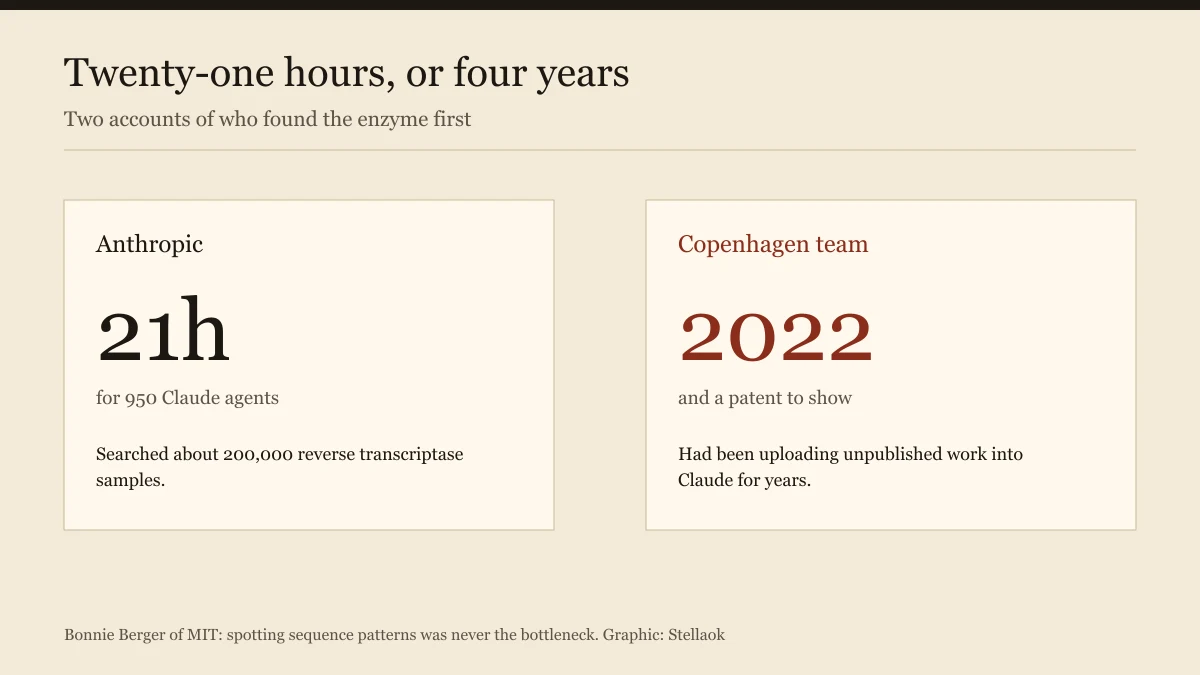
Anthropic says 950 Claude agents searched about 200,000 reverse transcriptase samples in publicly available databases and, in roughly 21 hours, identified a CRISPR-like enzyme that human scientists then confirmed was novel. Human involvement, the company says, was limited to writing the prompts and doing the lab work.
Mario Rodríguez Mestre, a computational biologist at the University of Copenhagen, told the New York Times that his team found this enzyme in 2022. "They are the same systems we have been studying for years," he said, pointing to a patent containing the research on which he is a listed co-inventor. CNET put both claims to working scientists.
The contamination problem is the serious objection
Mestre's team cannot say whether Claude found the enzyme independently. For years they had been uploading their own unpublished research into Claude to assist with their work, and if any of that entered training data it would have pointed the model straight at the answer.
That is not an accusation of fraud. It is a statement that the experiment cannot be evaluated, which for a scientific claim is worse. "I mean, coincidences happen," Mestre told the Times, and the fact that he has to say it is the problem. The result is either an impressive act of search or a very fast retrieval of something the model had already been shown, and nobody outside Anthropic's training pipeline can tell which.
His team's response is the part with real consequences. They are shutting down their Claude projects and moving to other models, just in case. Researchers withdrawing from a tool because they cannot verify whether it is reading their unpublished work back to them is a commercial problem for every lab selling into science.
The alternatives are not obviously cleaner. OpenAI faced the same accusation over the Navier-Stokes Millennium Problem and could not rule out that its model had trained on "deidentified data derived" from Levent Alpöge and Tristan Buckmaster, the mathematicians who actually solved it. Two frontier labs, two headline scientific results, the same unresolvable question about provenance.
What the enzyme actually is
Worth being clear about the science, because both the claim and the objection depend on it.
CRISPR is a bacterial immune system. When a bacterium survives a viral infection it copies a fragment of the virus's DNA into its own, building a library across generations. On a later attack it produces an RNA carrying the matching fragment, which guides a cutting protein to sever the viral DNA at precisely the right points so it cannot replicate. Researchers found it in 1987, worked out it could be repurposed for gene therapy, and took nearly forty years to get there: the first CRISPR medicine was approved in the UK in 2023 and by the US Food and Drug Administration in 2024.
Reverse transcriptase is an enzyme that builds DNA from an RNA template, the reverse of the usual direction. It defines many viruses including HIV, and understanding it is what made the first HIV treatments possible.
So the search space was real and the target class matters. Feng Zhang of MIT and the Broad Institute called the work "an exciting example of how AI agents can contribute to biological discovery," adding that the identification of RNA-repeat arrays associated with reverse transcriptases is "genuinely intriguing and merits further investigation." That is careful endorsement of the finding, not of the method's novelty.
Where the bottleneck actually sits
Bonnie Berger, who heads the Computation and Biology group at MIT's Computer Science and AI Lab, made the point that reframes the whole announcement.
"Scientists are finding interesting sequence patterns all the time, relatively speaking," she told CNET. "The bottleneck is then figuring out the purpose and function of these systems using deeper analysis, expert biological knowledge, and complementary targeted experiments."
In other words, spotting a candidate was never the hard part. Berger also notes how much unexplored territory exists: "We have hardly scratched the surface of exploring the biological systems represented in species sequenced outside of a handful of model organisms. So, many accomplished scientists could spend their careers studying interesting sequence patterns without getting to this one."
Her warning is the one labs should read twice. Careless AI-driven research risks producing "an overwhelming volume of low-impact observational findings that smothers important, targeted research on promising disease treatments." A tool that generates candidates faster than anyone can evaluate them does not accelerate science, it floods it.
Twenty-one hours against months of human work is a genuine speed advantage if the result holds up and the provenance is clean. Neither is established here. Anthropic has separately said Claude now leads 26% of its own research and development, and OpenAI has been reported to be working out how to announce a Hodge Conjecture result without picking a fight with mathematicians. The announcing is turning out to be harder than the computing.