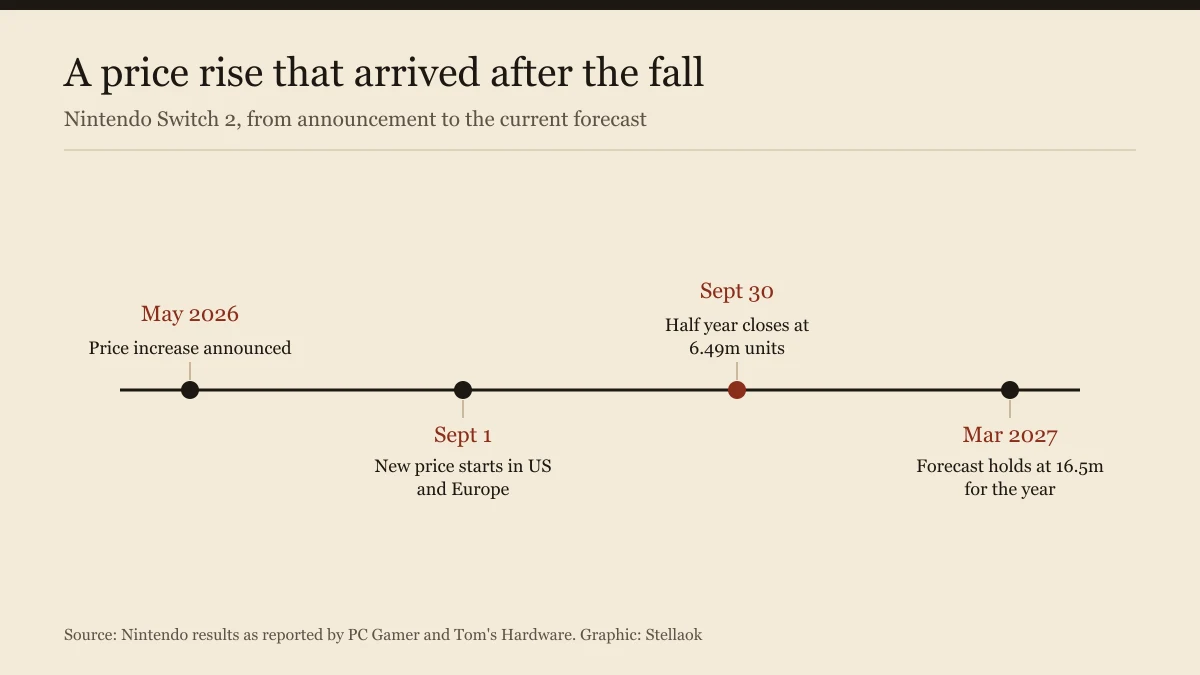
Nintendo sold 6.49 million Switch 2 consoles between 1 April and 30 September 2026, down 3.87 million from the 10.36 million it sold in the same six months a year earlier. The original Switch added 1.27 million units in the period, a decline of 32.7%.
The quarter-by-quarter picture is worse than the half-year total. Tom's Hardware, citing CNBC, put the July to September quarter at 2.67 million units, a 41% drop from the same quarter last year, and noted that Kantan Games chief executive Serkan Toto had predicted exactly that in June as soon as the price increase was announced.
PC Gamer has the full set of figures, including the detail that decides how to read the drop. The $50 increase, which took the console to $500 in the United States, Canada and Europe, only took effect on 1 September. Japan was the exception, raising prices in May.
The price rise arrived after the damage
That timing matters more than the headline percentage. If a console loses 37% of its volume in a half year before the price change takes effect in most markets, the price is not the cause of the first half. Something else got there first: a launch year that pulled forward demand, a thinner software slate, and a memory market that has been eating every hardware margin in the industry.
Games are the counterweight. Switch 2 software sold 24.49 million units in the six months, up 18.8% from 20.62 million. Set against 6.49 million consoles, that is roughly 3.8 games per machine, which is a healthy attach rate for a platform in its second year and a sign the installed base is buying rather than idling.
The older console is still where most of the software revenue comes from. Switch titles moved 65.73 million units, up 6.8% from 61.56 million, which is 2.7 times the Switch 2 software total on a platform Nintendo has been trying to retire for years.
Nintendo told investors the number it has to hit
The company kept its forecast for the year ending 31 March 2027 at 16.5 million Switch 2 units, down from 19.86 million in the previous twelve months. That is a 16.9% decline, and it now requires the holiday quarter to carry a much larger share of the year than the first two quarters suggest.
Toto's assessment, quoted by Tom's Hardware, is blunt: "Nintendo's only real blockbuster this fiscal year is the Ocarina of Time remake. It's not enough to make investors happy, especially after the device is now as expensive as it is."
That remake is out, and it is the release Nintendo rebuilt Hyrule around. Whether it moves hardware in the quantities the forecast needs is the open question. Pokémon titles are scheduled for 2027, which is outside this fiscal year.
Two supply problems sit behind the sales problem
The memory shortage is the first. Nintendo's price increase was blamed on "changes in market conditions", which is how hardware companies describe what memory prices are doing to a bill of materials. The same shortage has already pushed a supplier out of the game business entirely: Macronix has stopped making ROM cartridges to build flash for data centres.
The second is demand for the console's own catalogue. A platform that depends on one remake to carry a holiday season is a platform with a scheduling problem, and the fix is not a price cut. It is software that arrives on time.
The number to watch is the third-quarter report in February. It will show whether the $500 price held through the holidays, and whether Nintendo's 16.5 million was a forecast or a hope.