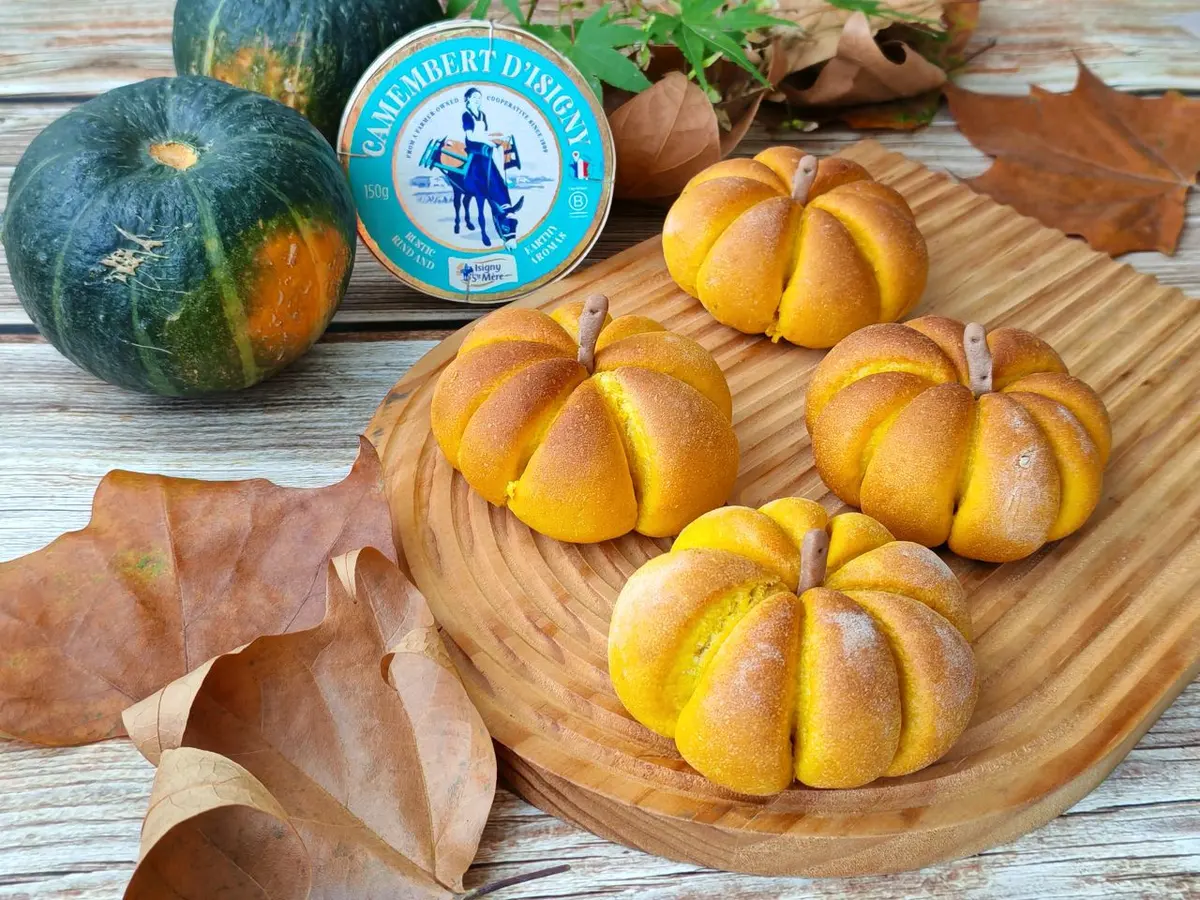
The string is doing two jobs: it scores the bun into petals as it rises and it holds the filling in place while the dough is still slack. Everything else is a standard enriched dough, with pumpkin in both the dough and the filling so the flavour comes through twice.
Chinese · Bread
Pumpkin Cheese Buns Tied Into Shape With Kitchen String
A soft pumpkin dough wrapped around a cream cheese and pumpkin filling, with a cube of camembert hidden in the middle, then tied with oiled string so it opens like a flower.
- Prep150 min
- Cook18 min
- Serves6
- LevelMedium
Ingredients
| 250 g | bread flour |
| 130 g | pumpkin puree |
| 130 g | milk |
| 25 g | caster sugar |
| 25 g | butter , softened |
| 2 g | salt |
| 2.5 g | instant yeast , the high-sugar type |
| 50 g | cream cheese |
| 15 g | caster sugar , for the filling |
| 150 g | thick pumpkin puree , for the filling |
| 15 g | milk powder |
| 50 g | camembert , cut into cubes |
Method
- Knead the flour, pumpkin puree, milk, sugar, yeast and salt, then work in the butter and keep going until the dough is smooth and elastic.
- Beat the cream cheese with the sugar, then mix in the thick pumpkin puree and milk powder to make a pipeable filling.
- Let the dough double, about an hour at room temperature, then divide it into six and roll each piece into a round.
- Flatten each round, put in a spoonful of pumpkin filling and one cube of camembert, then gather the edges and pinch firmly.
- Soak lengths of kitchen string in oil, then tie each ball with string in a cross so it is divided into segments.
- Set the buns on a tray and prove until doubled, roughly 40 minutes.
- Bake at 175C for 18 minutes, until the tops are deep gold.
- Snip the string off while the buns are still warm, before it cools and sticks to the crust.
Notes
- Oil the string properly. Dry string welds itself to the crust and tears the surface when removed.
- Use thick pumpkin puree for the filling. A watery one makes the cheese slide out during baking.
Ratios and technique checked against 辰辰妈dg on Douguo (南瓜奶酪包). The method here is written by Stellaok and the illustration is ours; no text or photograph from the source is reproduced.