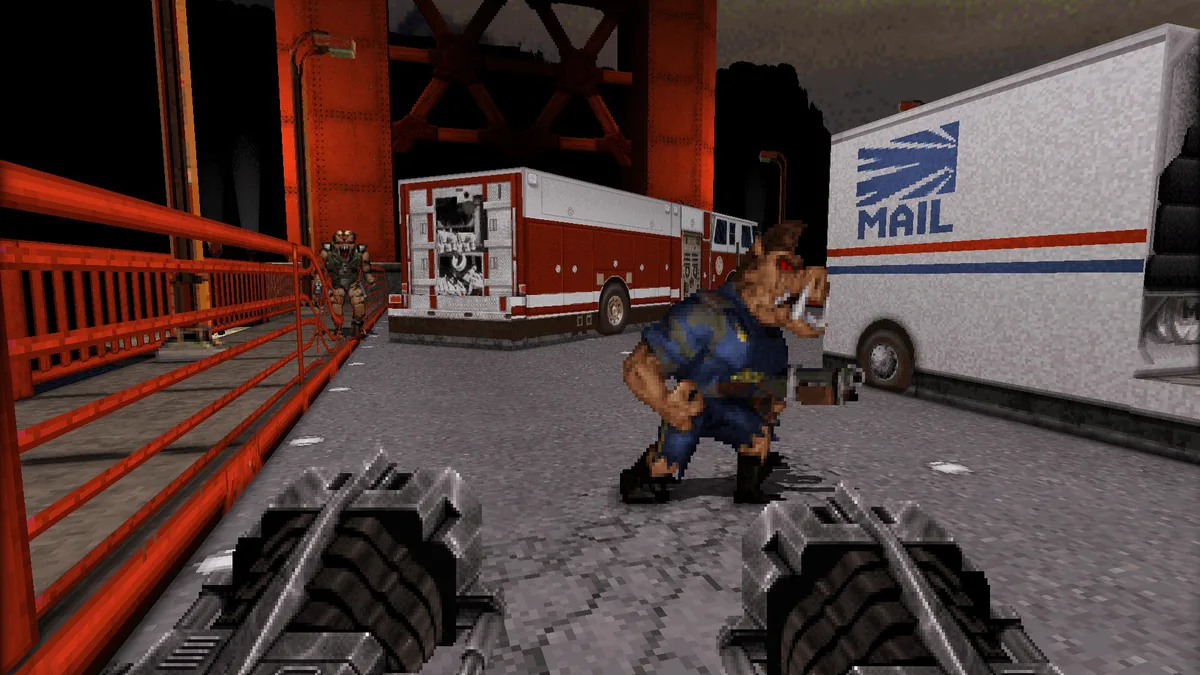
In 1998 a court ruled for FormGen, the publisher of Duke Nukem 3D, in Micro Star v. FormGen. Micro Star had sold boxed packs of player-made Duke maps under the name Nuke It and had asked the court to declare that it was not infringing. FormGen counter-sued. The maps, the court said, were derivative works of Duke Nukem 3D. PC Gamer's history of that market ran on October 10, 2026. The ruling is the one the piece credits with treating a video game mod as a copyright violation when the holder has not agreed.
PC Gamer's account sets the lawsuit at the end of a shelf of 1990s level packs. Some were official. The Master Levels for Doom 2 are treated as an expansion. Quake's Scourge of Armagon and Dissolution of Eternity were sold as official mission packs. Others were not. WizardWorks published unofficial Duke Nukem 3D packs. Duke Assault shipped with no curation, including unfinished maps from first-time designers and maps that killed the player on spawn. Nuke It, from Micro Star Software, was the infamous one: shovelware filled with player-created levels, boxed and sold. Denuvo has sued an anonymous cracker, Voices38, over bypasses in 26 games. A 1998 map case and a 2026 cracker suit are two generations of the same question, who may sell a piece of someone else's game.
Sunstorm was where the next mappers learned the tools
The packs the piece treats as the good ones came from sanctioned studios. Sunstorm Interactive specialized in Duke Nukem 3D and made Duke Caribbean: Life's a Beach, Duke It Out in D.C., and Duke Xtreme, three of the better-regarded add-ons for the 1996 game from 3D Realms. Charlie Wiederhold was a college student making maps for Rise of the Triad and Duke 3D. Sunstorm hired him after a level he built for a LAN event, the Duke Nukem 3D Rodeo Shootout. Randy Pitchford and Richard Gray, known as Levelord, were there. An archived Usenet post, Wiederhold's own advertisement for the tournament, is still on Google Groups. He recalls writing an installer for Sunstorm's Duke add-on, then getting one level in Duke It Out in D.C. He looked at the installer and the level and asked why he was still in college. He later worked on Duke Nukem Forever, Borderlands, and Call of Duty: Modern Warfare 2.
After the ruling, the boxed mission pack went away
The 1998 holding is what the piece calls the end of the unregulated pack. A mod counts as a derivative work. Selling it without consent is infringement. Developers who want mods, the piece says, are choosing to allow them. The unofficial shelf then sorted into official expansions on one side and mods on the other. Mapping did not stop. The piece names Arcane Dimensions, an unofficial Quake project, and Dawn of the Machine, an official new Quake episode, as later work in the same line. Wiederhold pushing the Build engine is the thirty-year-old version of that impulse. PC Gamer calls Micro Star v. FormGen a landmark in U.S. copyright law, a holding about mods as a class rather than about one box of maps. The unregulated pack, it says, died out quickly once that class was drawn. Later add-ons arrived as official expansions or as mods a studio had decided to host. Valve said a personalized sale showed people ten times as many games. A store can surface an old shooter. The 1998 rule is what stops that store from selling a stranger's maps of it.
The consent the court required is still the line between a mod a studio hosts and a box a publisher can sue.